Archive | Ironman Race Reports RSS feed for this section

Ironman World Championship 2022

18 Oct

This is a journey that has taken 16 years, from my first Ironman branded race in 2006 at Ironman Austria, when I had a finishing time of 14:26:31 to October 8, 2022 when I had a finishing time at the Ironman World Championships at Kona of 14:10:06. Seems like not much has changed in 16 years, and yet a whole lot of training, some blood, a ton of sweat and more than a few tears have flowed during that time. As usual, cutting to the quick, the results on the day, were as follows:

Swim – 1:23:40

T1         – 11:46

Bike      – 6:14:11

T2        -15:55

Run      – 6:04:35

Like any good story, this does have a beginning, middle and an end. Triathlon is a wonderful sport, three disciplines that create some incredible fitness and a solid aerobic engine. It has been my experience that the sport also supports an above average amount training while lowering the probability of injury given the need to train in 3 different sports.

My beginning truly was in 2005, when two buddies completed Ironman Lake Placed – I had beers with Stew and Christian to hear the tale of Ironman. Of course, throughout the discussion they chastised me for only competing in sprint and Olympic distance triathlons – I needed to step up and be a man – race Ironman! Listening to their experience I certainly had caught the bug, but unlike my bachelor buddies, my family had 3 kids (Corbin (12), Austin (9) and Maddie (5)) and Dianne was running our house and a full-time business. After that night out, it was time to have a discussion with Dianne and to her incredible credit, when I asked her about me completing an ironman, she said that no time was perfect, so I might as well get it done. Of course, when she made that comment, she probably didn’t anticipate sitting in Kona 16 years later, still supporting this passion for long-distance triathlon! Thank you Dianne, if it wasn’t for your support, your patience, your willingness to deal with a hangry husband and your wonderful trip planning capabilities to make the most of these events, this would not have happened.

Fast forward to Kona 2022. For 15 years I have been hoping to deliver a fast enough time to qualify for Kona – the World Championships for Ironman. I had essentially given up on qualifying with my speed and was now focused on qualifying as a Legacy Athlete. Ironman created this segment to “reward” loyal competitors who had raced in at least 12 Ironman branded long-course events (events with a 3.8km swim; 180km bike and 42.2km run). Once you completed your 12th event, you then registered as a Legacy Athlete and then you went onto a wait list. While on that wait list, you needed to complete an ironman each year to prove you were still capable of completing an ironman. As we headed into the 2020 year, I had booked 2 ironman races early in the year in my attempt to complete 12 and register as a legacy athlete in November 2020 – I then expected to be on the wait list for 3-4 years given the backlog of legacy athletes waiting for their turn. Of course, we all know what happened in March 2020 as COVID wreaked havoc on life. I had to defer the two early races in 2020 I had even booked two additional in late 2020 hoping that COVID would clear – of course, no such luck – deferred.  

2021 would continue to see a bleak race year, with travel challenged and gathering restrictions in place, getting my races in was not looking promising. An opportunity popped up to race Ironman Lake Placid with the Executive Challenge group of Ironman. Ironic that my opportunity to qualify for Kona was coming full circle to that conversation over beers with Stew and Christian. Given the lack of races in 2020 and 2021, Ironman was allocating an unprecedented number of slots for Kona 2021. If I could finish within the Ironman XC group, I had an excellent chance of qualifying for the World Championships in 2021. Well, I finished the race at LP and punched my ticket to Kona. Of course, nothing is ever that easy, particularly in this COVID world. Kona was cancelled in October 2021 and rebooked for February 2022, this was cancelled and rebooked for either Utah in May or Kona October 2022. Each of these required booking and cancelling flights, hotels and activities all of which was creating its own headaches and anxieties. Through all of this, I was given the option of racing in St. George Utah or Kona, of course this was a no brainer, we were going to Kona – of course only if COVID permitted.
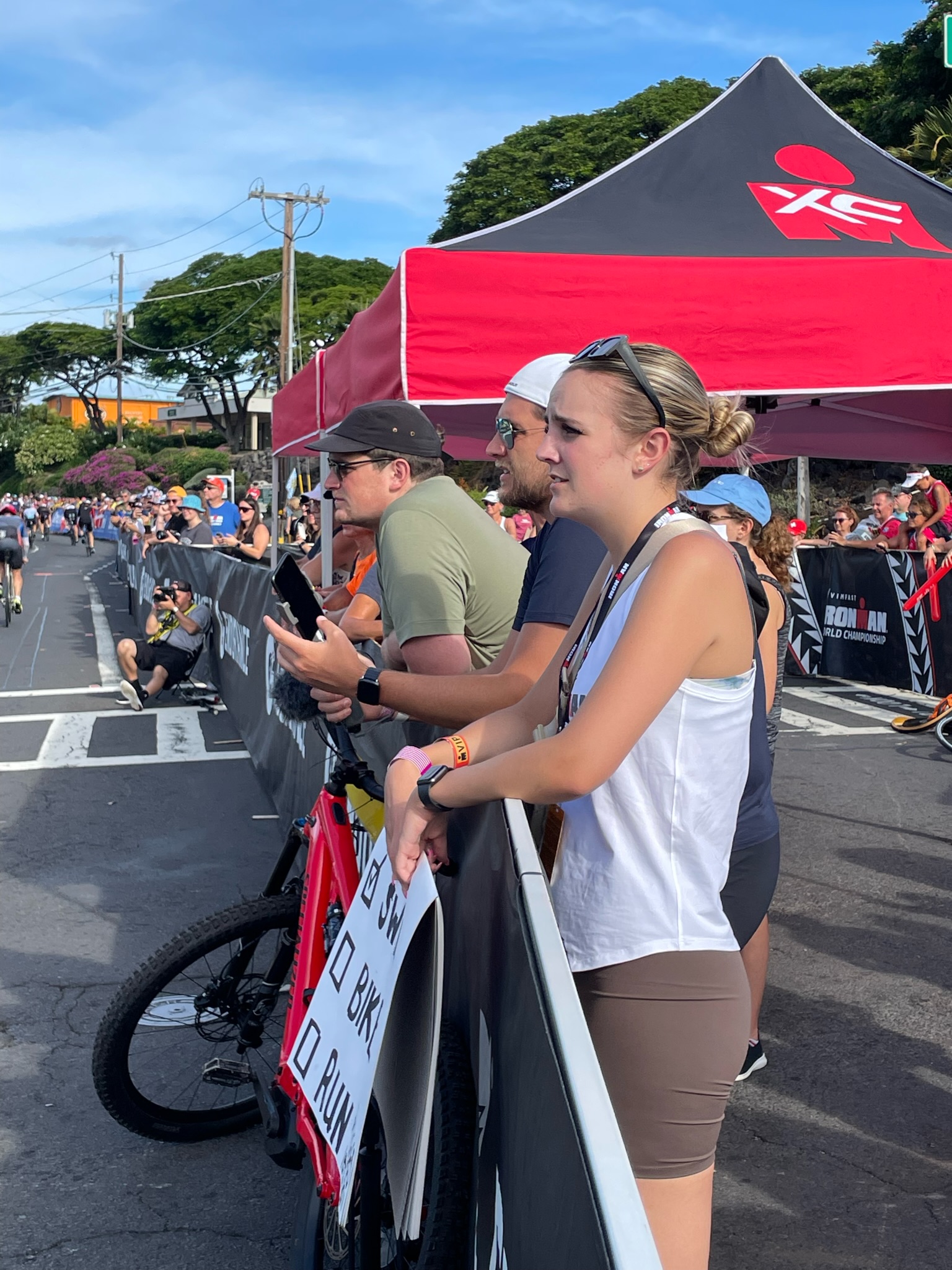
The trip to Kona has been a long-time coming. Hawaii is a wonderful place to vacation by all accounts but I had told the family that we would only go if I had qualified for Kona. Well, I had and now I was hoping that the whole family was going to be able to carve time out of their busy lives to join us for this once in a lifetime trip. The kids were able to block their schedules and away we went on September 24 for two weeks of a wonderfully curated vacation (anyone wants tips on what to do in Maui or on the Big island, just ask Dianne) and one day of tough slogging for athlete and spectators.

The weather in Hawaii seems to be hot all of the time. Watching the weather app for weeks leading up to our departure, the days saw highs of 30 celsius, feels like 38! Of course, during the evenings it dropped to a more reasonable 28 feels like 30! For those of you who have read previous race reports, you will know that heat has not been my friend. While I had been training during the last few weeks with the hot box (a home made plastic tent that I put over my bike and heat to 37 Celsius during training sessions) and we had a full two weeks to acclimatize in Hawaii, I was still quite worried that the heat could get the better of me. It was just 10 weeks ago that I dnf’d Lake Placid in the heat as my stomach turned over and my mind quit. This was Kona, I had to finish this race.

We had a wonderful week in Maui – it is not always easy to travel and be with your family 24/7 but we had a great time. We had rented a house that gave everyone their own space, we had a pool to lounge by and Dianne had created an itinerary of sightseeing that everyone loved. From snorkeling, to golf, from seeing the sunrise from the top of Maui, to watching Dianne paraglide, to playing golf, driving the road to Hana and going to a Luau, we had a busy week. Originally I was going to ship my bike directly to Kona, but the cost made me gag (which is ironic given the general cost of travelling to Hawaii) so we brought it with us. I decided not to unpack it until we got to Kona, so the week in Maui was focused on running and swimming in the final prep for Kona. We had a wonderful VRBO, but the downside was that every road out was down a hill, which meant every road back was climbing. I had found an Olympic outdoor swimming pool, that was about 8k from the house, which made it easy to be dropped off to have a swim and then run home. Of course, the run home was all up hill! We spent a lot of time in the heat, getting used to the sun baking your skin (lathered with reef safe sunscreen that doesn’t come off your clothes – something to remember!!)

Race Day
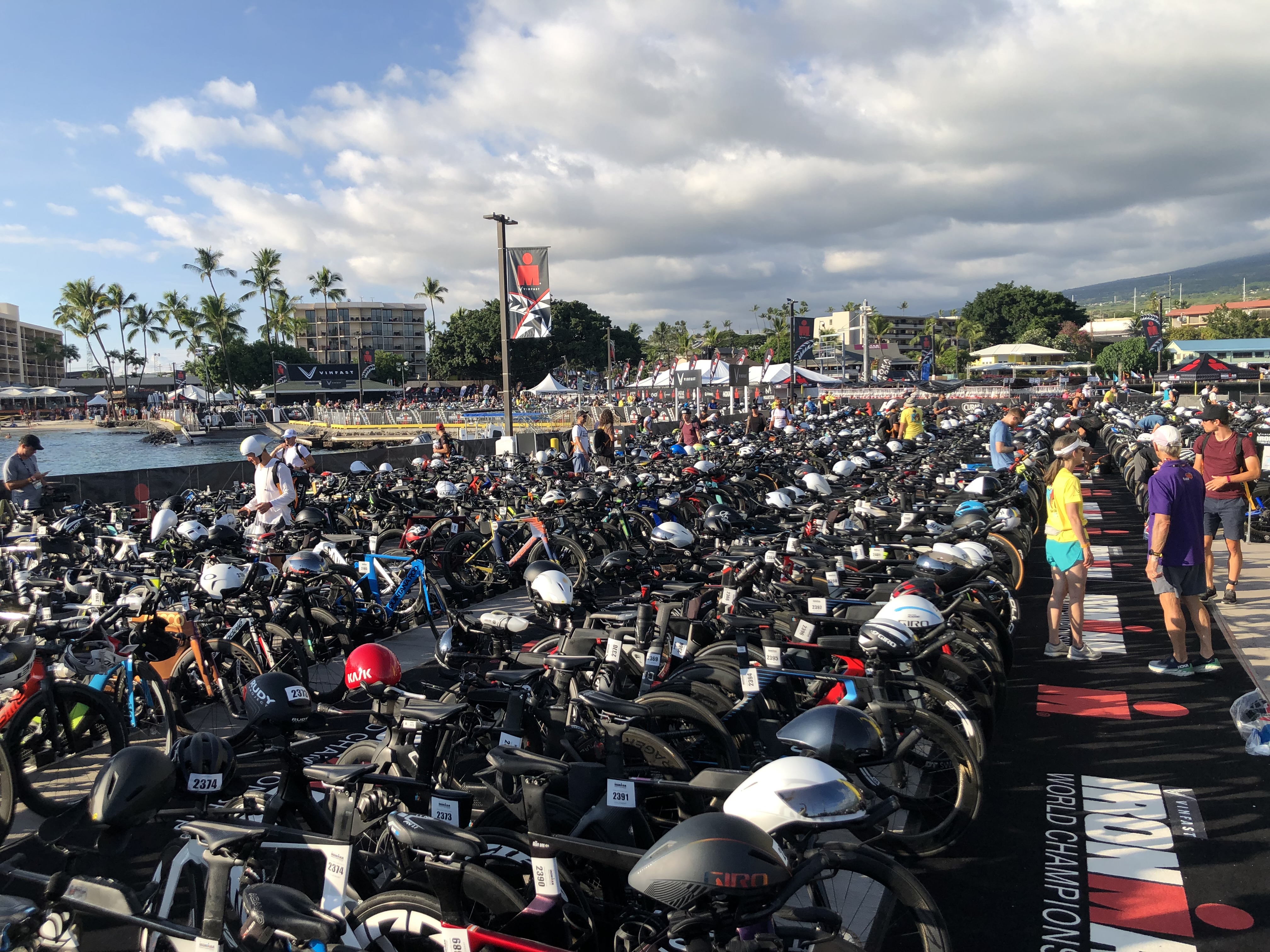
There is my bike, right where I left it! 🙂

Before I get into the actual day, one of the many challenges of this World Championship was the fact that they were attempting to host twice the number of athletes as usual (5,000), which likely meant at least twice the number of family spectators, for an island that has not grown over the last three years (since the last WC in 2019). Indeed, most states have experienced labour shortages and Hawaii was not an exception. In order to make this happen Ironman planned the event over two days, Thursday – All women and 2 men’s age-groups would race and then Saturday the men would race. We had a briefing from the CEO of Ironman who suggested that as a result of racing on Thursday, a work day, the number of volunteers were significantly reduced and this would mean the “service level” would be reduced. What does this mean you ask? Well, historically, after you were finished on your bike, they would have “bike catchers” available to take your bike from you and rack it while you ran through transition to grab your run bag. Perhaps more importantly, this meant that there would be fewer aid stations on the bike and the run. No doubt there were several other decisions that were made, but these would be the most obvious to a rookie. Given I raced on Saturday, why did this volunteer shortfall on Thursday matter to me? Well, Ironman felt that the fairest outcome would be to replicate the conditions on both days – both days would get the same level of support irrespective of available volunteer pool. And so, the race day would begin:It is amazing how fast things happen. Having waited so long to get here, I wanted to take it all in yet I wanted to get going.  Dianne and I stayed at the race hotel on Friday night so that we would have easy access to transition and the race start. The kids were troopers staying at the house and had to get up at 4:00am. Austin and Maddie had made me waffles and they got down to our hotel for 5am before the parking closed for the day. They arrived on time and I was now up, ready to get going. I needed to get bodymarked, drop off my special needs bags for the bike and run, put my hydration bottles on my bike with my gel flasks (unlike other races, we did not have access to our run or bike transition bags before the race, which meant I had to stack everything on the bike) and then wait for my 7:35 start. The pro men were starting at 6:25, so they would be finishing the swim before I even started. Dianne, Corbin and Maddie went out to the pier to see the swim start, Austin hung with me, helping to apply sunscreen, added some re-skin to chafing areas on the back of my neck (I was wearing a skinsuit, which is supposed to make you faster in the water as it repels water – I don’t wear this normally and I had found it chafed the back of my neck in practice) and keeping me loose as the tension mounted. In the hotel room, we watched the men’s pro race start at 6:25am and several age group waves, before we headed down to the swim corrals. Austin walked me down to the corral entrance chute and gave me a big hug and said “you got this Papi” it made me cry to know that my kids and Dianne were right there with me for this journey. I was supposed to be in my corral for 7:15, but I hovered at the pro-bike transition and was there to see the first pro-men come out of the water and get to their bikes. It is incredible how fast these guys are transitioning from one sport to the next. As my 7:35 start time got closer, we were cattle prodded to the entrance to the small “Digby Beach”, where you access the water and swim 100m or so out to the swim start. As I was coming through the chute, I could see Corbin filming the athletes going into the water, so I gave him a big wave and thumbs up. For the next 10 minutes or so I would swim out to the start, stay about 10 meters back from the line and just wave to Dianne and Maddie who were also out on the pier watching. They could see me in the group as I had a distinctive Blue Ironman XC swim cap (hmmm, blue and ocean might not be so contrasting or distinctive) versus the green caps of my age-group wave.

The Swim – 1:23:40

Yes that is me with his hand in the air – Staying back from the frenzy or so I thought.

To provide some perspective on the swim, I have 13 competition long-distance swims under my belt (all wetsuit swims) and they have generally been between 1:14 (Lake Placid this year) and 1:18. I have had one ocean swim at Ironman France, while all the rest have been freshwater. In kona, you are not allowed to wear a wet suit and the ocean can be much more unpredictable than the freshwater lakes that you typically swim in (although some of my practice swims in Lake Ontario can easily rival the chop of the Pacific Ocean). For this race day, it was only men (all the women and some men raced on Thursday) and we were the oldest age group racing on Saturday. The organizers had decided to seed us as the second last group to start with only the young bucks (18-29 year olds) behind us. This should have meant that the swim would have more open water space than usual (areas to just find your swim groove without worrying about other athletes crowding your space) and far less body contact –I really should not have been surprised that nothing could have been farther from the truth at a World Championship!! With almost 400 athletes aged 55-59 competing on the day, the water was churning. When the gun went off, there was barely room to breathe. I had positioned myself back of the start line (I am not a fast swimmer) and to the middle of the swim start buoys thinking it was the best line for the course (it seemed everyone who raced on Thursday started at the right start buoy). Clearly I was not alone as the kicking and slapping was incredible. This is made worse by the fact that you don’t have the padding of neoprene between you and that kick to the arm or shoulder or punch to the leg or slap to the head. This cleared up after about 300-400 meters only to happen again at irregular intervals around the course. The wave action seemed reasonable early but got rougher as the race progressed as the swells were building, or so it seemed to me – a novice ocean swimmer. I had been warned, by an 11 time Kona competitor and friend, that starting later meant that we were likely going to have adverse tidal action. Not having swum in different ocean conditions, I didn’t quite know what that meant or how I should plan for it when swimming.  For those of you who have swum 3.8 kms, you know it is a long way and I have to say when you look out to the turnaround boat far on the horizon, you wonder once again what you were thinking when you paid money to race Kona.

While the swells played a role and the body contact was a challenge, I actually felt like my pace was solid for a non-wetsuit swim. I had anticipated that if I could get to the turnaround boat by 40 mins, I would be happy and as I turned the right corner at the red buoy and the bow of the boat, I paused to look at my watch, I was 40:40 – so far so good.

The rest of the swim was a focus on swallowing as little salt water as possible, catch as many feet as possible (allowing you to swim faster with the same energy or swim the same speed with less energy expended) and do my best to not take more body blows as many of the young bucks were now overtaking us in their red swim caps. This swim is iconic, not just because of the start off of Digby Beach, but the finish along the pier, where millions of dollars of bikes sit waiting for their athletes to arrive. This is definitely memorable from watching years and years of tv footage. This time, was my time, and I would look up at the pier to see if my family was there cheering me in – not there. Ok maybe they were positioned just around the corner as the pier cuts back to the left – not there either.  Clearly I had forgotten that I told them not to wait for me at the pier but rather go up to the “hot corner” where we started out on the bike course.  Ok, I got to the beach, climbed those stairs and had a little fist pump celebration – check task 1 completed.

T1
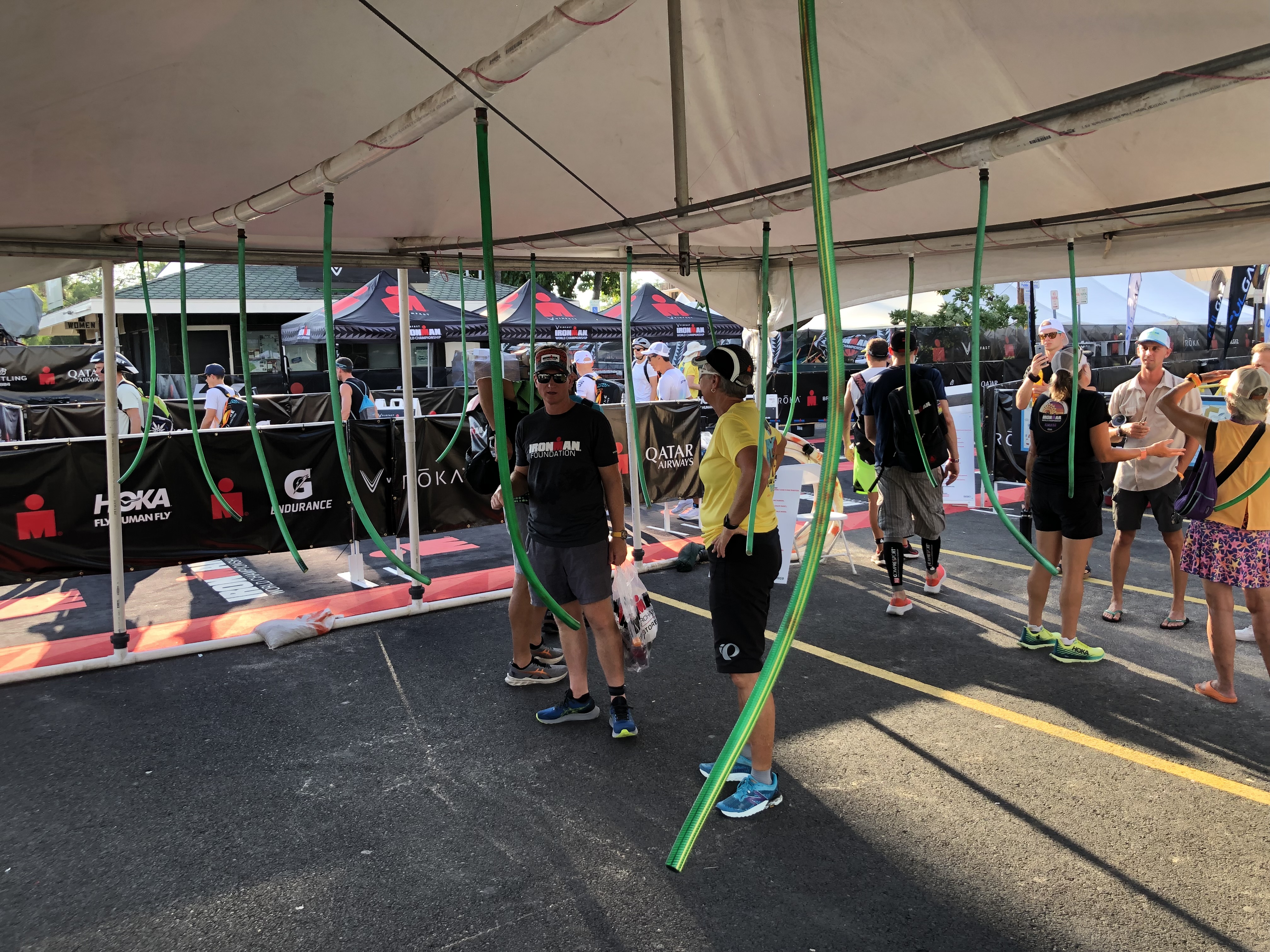
Use the freshwater to get rid of the salt

I was going to take my time going through transition. I wanted to ensure that I was setting myself up for a positive experience. First – spend time under the freshwater hoses, Bill Best told me to get the salt water out of my hair so I didn’t sweat it into my eyes – done. Flush out the crotch so that we minimize the chafing on the bike and run – done. Spray the cool water on your body, to try and cool yourself down – done. Grab your cycling bag from a volunteer – smile and thanked them for being there. Get into the change tent – go pee, put on socks, calf sleeves, shoes, sunscreen the lower back, sunscreen the legs, the arms, the ears, the neck, put on my custom race top (thanks Fam)(I did not wear my race top under my speedskin during the swim as I found that I chafed under the arms during a practice swim – more evidence of not doing anything new on race day), put some Vaseline in the crotch area, eat a maple syrup gel, chase it with 250ml of water, put all my swim stuff back in the bike bag and go get my bike. Once I exited the tent, you run the rest of the pier and then to your bike where I loaded the nutrition into my race top, pulled on the helmet and started running with my bike. I smiled at and thanked as many volunteers as possible (they were easy to see all dressed in yellow, Dianne and the kids all volunteered at Thursday’s race) – I finally got to the mount line pulled to the right, jumped on the bike and now I was into the segment of the event that I enjoy the most!

The Bike – 6:14:11

Kona is renowned for a tough bike, the heat, the climbing and at times the unforgiving trade winds can wreak havoc on the cycling portion of this race. Again, my veteran racing buddy had warned that our later race start would mean that we would experience the worst of each of these conditions (of course the climbing would be the same). To provide perspective, my bike has always been my strongest discipline although there have been many occasions when pundits have suggested that I went out too strongly on the bike and that is what caused a collapse on the run. In training, I was posting long rides at approximately 30km/hour but in the more extreme Ontario heat that was dropping to 27-28km/hr. I would be happy with a ride of 6:15-6:45 – a wide gap but expected given the huge variance in conditions. Normally I would focus on power or watts, which in my case was a planned 185 for the front end and up to 200 if I was feeling good on the last 40km or so. However, as Matt Dixon of Purple Patch suggested to me, this race course makes a focus on power more difficult given the undulations and wind.

Starting up Pilani to get to the Queen K – My Cheering Squad

Once past the mount line for the bike, you ride 150M or so up the steep hill of Pilani drive where you make a left turn – dubbed the hot corner as you pass by it 6 times on the day – my whole family was there to welcome me with huge cheers – the biggest I would hear from anyone all day. It is an incredible lift to know that your whole team is there to support you in these types of efforts and while it was still very early, I knew I was finishing this race. After passing my family, you ride in a square to bring you back past the hot corner and do a little ride south before retracing your route back to Palani drive and some quick climbing to the iconic Queen K highway. Again my family was waiting for me as I climbed that hill giving me some big cheers, something that would keep me company for the next 5.5 hours before I would see them again.

The heat in Hawaii is unrelenting and while I believe Saturday was not as hot as it could be (Thursday’s race was probably hotter) it is still freaking hot. The sun just bakes you and there is little to no reprieve from trees, after all you are racing on lava fields!! Going into this race, the bike was a focal point for a few reasons. As I suggested earlier, heat has never been my friend. I suffered mightily in the Furnace Creek 508 (I should have known from the race title – duh), and I dnf’d Texas and Lake Placid, both very hot races. So my focus for Kona was to ensure that I was paying attention to my core body temperature by taking every opportunity to cool it down, ensure that my hydration and nutrition were supporting the demands I was putting on the body in the heat. So here was the plan for the bike: wear my regular cycling helmet rather than aero helmet as it comes with more ventilation and access holes to get cold water to my head. Carry insulated bottles to try and have access to colder water/gatorade. Drink a gatorade mix that had elevated sodium levels (660mg/700ml) at 1L/hour. Eat Maple Syrup gels with sodium every 40 minutes. Every aid station, I needed to do something – I had to make every one of those limited number of stations work for me on this race day. It mattered even more that I took the opportunity to hydrate, cool and feed at each station.  As I approached every aid station the routine was almost the same, I would open up my down tube polar bottle, stick the lid in my shirt. I would open the top of the speed fill drink bottle on my aero bars and pour in my pre-made pre-measured gatorade concentrate. As I entered the aid station, I would call out water and point to the first volunteer with a bottle, grab it, pour it into the polar bottle, add to the aero bar bottle; all the while rolling slowly through the aid station. I would have time to grab another water bottle, fill the remaining aero bottle and then douse myself with the rest of the water. On some occasions it was two bottles over my body.  This became my focus on execution.

One of the benefits of being old and being seeded near the back of the bus, was that you could actually race your race. In Ironman racing, you are not supposed to draft on the bike, which means your front wheel can’t be within 40 feet of the front wheel of the cyclist ahead of you. If you go into that “zone” you must pass the rider in front of you within 25 seconds and if that doesn’t happen, then you can risk getting a 5 minute “drafting penalty”. On this day, when I came into the bike transition, mine was one of the few still left on the pier, which meant I was going to riding for much of this race with very few athletes around me. This meant that I could race my race and I wouldn’t need to worry about packs of cyclists, I would be able to manage my passes strategically, I could manage heart rate and power without needing to take actions that were necessitated because others were being aggressive.

On this race course, there were many things to think about while you were out in the lava. Which way is the wind blowing (look at the grasses at the side of the road), how hard is the wind blowing (look at the ocean – are there white caps forming?) watch the cyclist ahead of me to see if they are getting pushed around, take advantage of the hills at the highway’s edge to drink and eat as you will have some relief from the wind and look at the surrounding mountains – where they form valleys will likely be the areas of greatest wind gusts. So between getting hydration, cooling, nutrition and understanding what was happening around you there was lots to keep your mind busy. Of course, there is stunning beauty within the lava fields, the ocean and closer to the turnaround of Hawi, the greenery of the start of the rain forest.

My bike was relatively uneventful, my speed going out to Hawi and the turnaround was hovering around 27km/hour and my nutrition and hydration plan was going well. I felt like I had energy and the temperature of my body felt reasonable. The cooling plan felt like it was working and importantly the sunscreen plan was also paying dividends (I applied sunscreen before I went to bed, when I got up and after the swim) – my body was not going to be fried, which meant I had a chance of performing. The ride up to Hawi is about 20 miles and it is mostly uphill. The wind felt like it was in our face, but I couldn’t see any whitecaps on the ocean to the west of us, so I knew it wasn’t a big wind. Watching the cyclists returning, I could tell their speed was high and so it felt like there was time available to be made up on the way home.

I made the turn at Hawi and stopped at the special needs station, I had packed an extra gel flask of maple syrup and a concentrated bottle of gatorade/sodium. I also packed some potato chips. I pulled over, methodically transitioned everything, had some chips, went to the porto potti and then was back on the road – probably 4-5 minutes of total stopping time, but again I felt like it was sowing the seeds of success for the next 85kms of the bike.

From here on, I was still very focused on cooling the body as we were in the heat of the day. While I had been aggressive with my hydration on the first half of the bike, I could feel my body was starting to resist taking in the same load and so I moved to more water than gatorade. My gels were also extended to just 2.5 over the last 3 hours. I felt good and continue to push my speed, moving the average from 27 to 29km/h – I wasn’t sure that with rolling hills going back to kona and changing wind directions, that I was going to be able to sustain the effort.

Getting back into town the route zigged and zagged behind the local Target store and you pass by the hot corner. Once again, the family was out waiting to cheer me on with signs and huge amounts of energy, something that would once again get me going as I headed out on the run. As I entered T2, I had the realization that I was “just a marathon away” from reaching a dream goal of mine. My total time to that point was almost 8 hours, which meant I had a maximum of 9 hours to complete a marathon. While it is a toss away line to suggest that most anyone should be able to walk 42.2kms in under 9 hours – strolling less than 5km/hour; I had seen first hand how hard things can get just 2 months prior if your mind and body quit.

T2

I spent T2 ensuring that once again I was setting myself up to finish. I changed into running shorts from my tri-kit shorts, I lubed up the crotch once again, put on some more sunscreen, new socks and sucked on ice. I also took a cold towel with me and rolled ice inside and slung it around my neck. Another gel before I left transition and 250ml of water. As I left transition, I filled my handheld bottle with gatorade and ice and off I went to run, jog, walk or crawl 42.2kms to the finish line.

The Run – 6:04:35

Now, in training I have never paced a run that would result in a marathon time of 6:04, that is just a long-time out on the road – . As my buddy Jeff Leisk suggests, it seems harder running 6:30/km pacing than it does 5:45s – so imagine how hard it must be to run 8:36/km – a snail’s pace!!
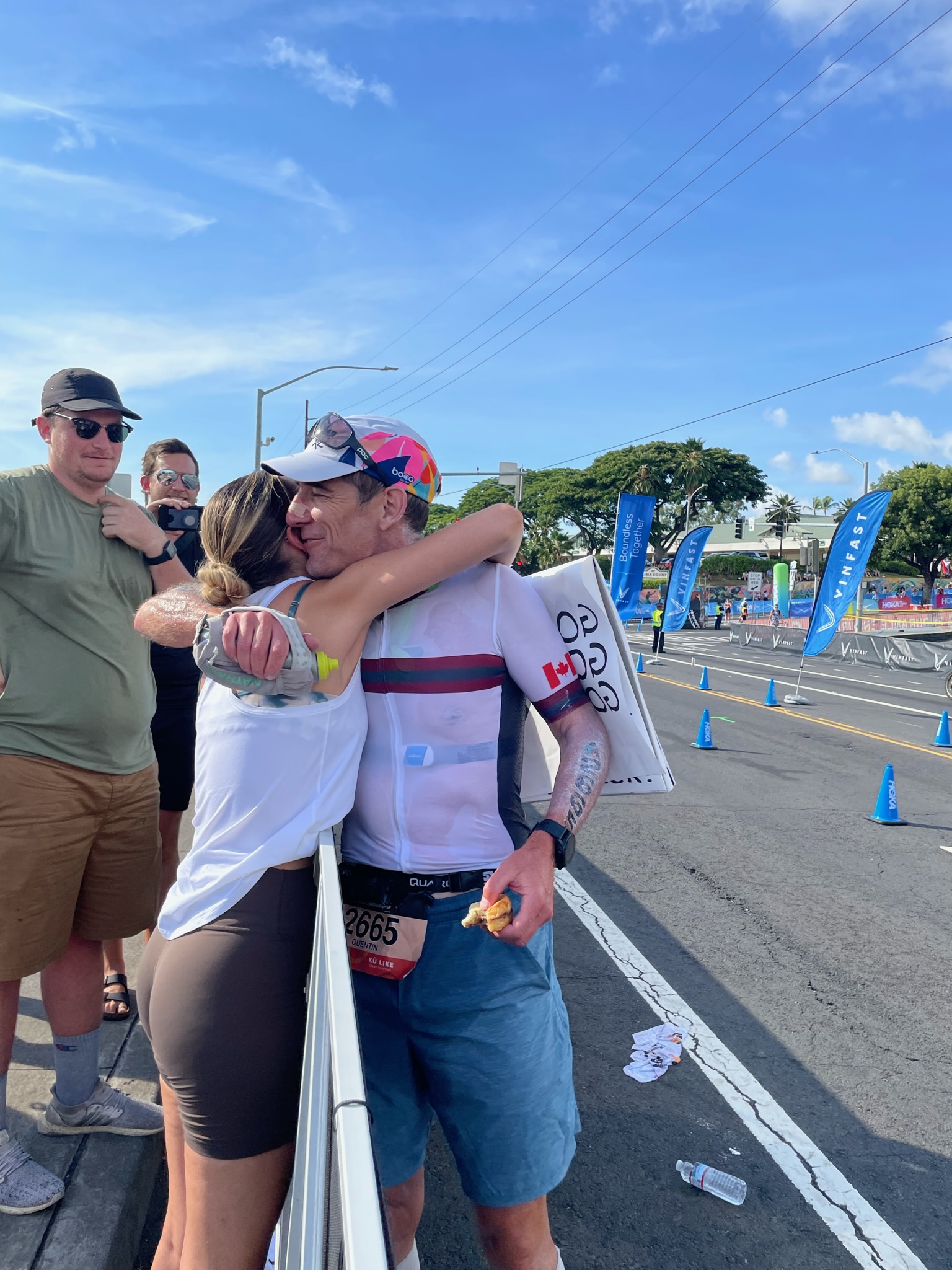
Greeting me as I begin the Marathon

Well, I came out of transition and started the climb up Pilani to begin a 10k out and back section along the waterfront of Ali’i Drive. The family was once again right there, ready to cheer me on and my spirits were high. There is a ton of cheering going on in this section of the race – bars, food and shade are more readily available and you can see your athletes a few times. Again, got big hugs from my team – with Maddie suggesting that would be the only time she would give me a sweaty hug. For the next km or so I trundled along, giving smiles and getting cheers but increasingly feeling challenged and drained. Despite all the work that I had done to keep my body cooled, I could almost feel myself baking and just began slowing down (and that is something given how slow I was going already). I started to problem solve and felt like I need to go to water and access more ice. By about 5km, my walking stints were now 2 to 1 over my running stints, my persona had turned dark and it felt like I was in for another very challenging marathon. By km 7, I got the bright Idea of putting my upper body into the garbage cans filled with red bull, ice and water. The red bull was only important because it was being housed in the garbage cans filled with water and ice and that ice was not being consumed by athletes. So it was the perfect opportunity to cool the core. So at each aid station now, my process was to empty my handheld bottle of its contents, add one cup of water, two cups of gatorade and as much ice as I could jam into the bottle (of course the cubes never really fit so you definitely needed to argue with them to get them in), then I would find the red bull can and jam my arms in for a minute, then fill my hat with ice from the bucket and it was at this point that I exited the aid station – did you get all of that? Of course, this would mean that I was spending about 3.5-5 minutes or more at each station (my Garmin suggested an average of 4 minutes). How many aid stations you ask over 26.6 miles – 18! So that would suggest that I probably spent 60+ minutes dilly-dallying trying to beat the heat. By the way, I was still trying to cool myself at the last aid station at 25.1 miles.

By the time I was done 10 kms, I was back to the point in the course where athletes turn right to go to the finish line or turn left to do the out-and-back that I just finished. Boy does that feel awful even a bit sadistic. You know that finish line is about 500M away but you have another 32kms to “run”. Even more sadistically, given you have completed 10km (which you won’t repeat about 8km of it), you know that when you hit the halfway point of the run (21.1km) you will still be running AWAY from the finish line very likely in the pitch black of Kona evenings/night. Now, it was just about ensuring that I finished without major challenges. It was going to be about 16kms run out to the energy lab and I was secretly hoping I could get there before dark – HA, HA, HA – no chance. In Kona it is light out until the switch is turned off and then it is dark out. By about 6:20pm, it was quite dark, no cars to light the way and no street lights. Unlike every other ironman race I have competed in, there were no generator mobile lights on the course. It was just you and a light stick.

I finally got out to the natural energy lab – still not sure why they call it that, but I certainly didn’t get any energy from it. I came to the aid station and once again I thought that I should have a maple syrup gel to keep my energy up. Gel went in and I promptly headed for a lava rock to sit down and puke out all of the liquids in my stomach – been here, done this too many times!! Ohhh No, get it together Quentin, figure this out. Well, time to go to just water and nurse things back to life. I got back on my feet and started trudging along to the turnaround that would finally take me back to the finish. At that point I was passed by a guy with a headlamp! Brilliant, follow this guy to Mecca and he would light the way. So I got on my horse and my pace picked up to 7min kms, not much of a pace, but far better than walking. So from here till about 5km left, the routine was the same, I would hang on to him till we got to an aid station, I would bail to do the ice bath, ice in hat, fill bottle with cold water and stuff ice in the bottle – rinse and repeat. I would then get my pace and try to work back up to the guy with the light. During the periods when I lost him, I would be constantly negotiating with myself on my running effort. Ok, see that sign, when I hit that, then start running for 4 pylons, get to the 4th pylon then negotiate another 2 pylons and so it went. There were large Hoka (sponsor) mile markers that were illuminated, those became easy marks to start my run or finish the running and start walking. I had one thing in mind…..just keep going don’t stop and lay down, don’t sit down at the side of the road, don’t let the darkness bring down the desire to finish – just FINISH!

By 5km remaining, I knew this was a done deal. I still couldn’t see Pilani Drive in the dark, but I knew it was a maximum of 40 minutes (yes I was still booking 8 mins/km). I also knew that when I turned right on Pilani and started down the hill, the energy levels with about 2kms left would be elevated and I would have crowds to cheer me on and my family would be waiting. As I made the left turn at Pilani, Austin was waiting for me with big open arms, I took a big hug from him and we began the fast walk to the finish line. It was a great feeling to know that there was nothing left but to soak in the finish chute energy, give as many people as possible a high five and ensure that I didn’t look down to turn off my watch when I went under the finish arch.
Walk run to the finish line.
Holding Me Up!

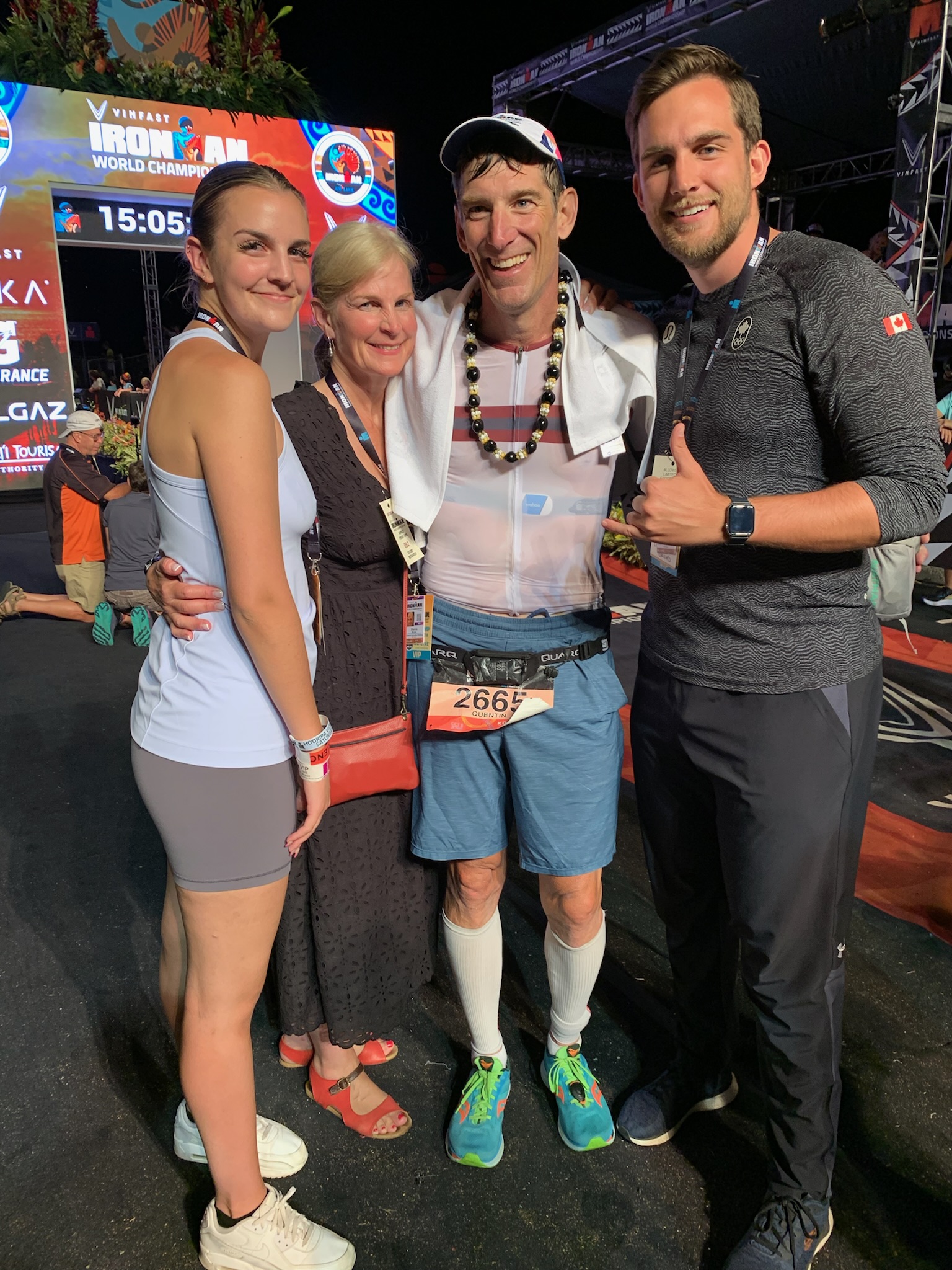
The finish line here is truly iconic with the biggest and loudest crowds I have ever experienced at an Ironman. To put it in context to the other major milestone event – the Norseman – there was a photographer and my support crew at the mountaintop finish line. Well, I made sure there were no other athletes coming at the same time, hoping that Mike Reilly would call me in, indeed as I stepped over the threshold, Mike Reilly announced “Quentin Broad, you are an ironman”! I looked right and saw the rest of my family come out to greet me and give me hugs – you know they love you when they give you hugs when you are hot and sweaty. After getting the hugs and some photos, it was time to get my medal, t-shirt and hat; and then go to the food tent. I was feeling a little woozy, so perched over a garbage can thinking I was going to lose my cookies again. The volunteer was rubbing my shoulders and my family was hovering in support.
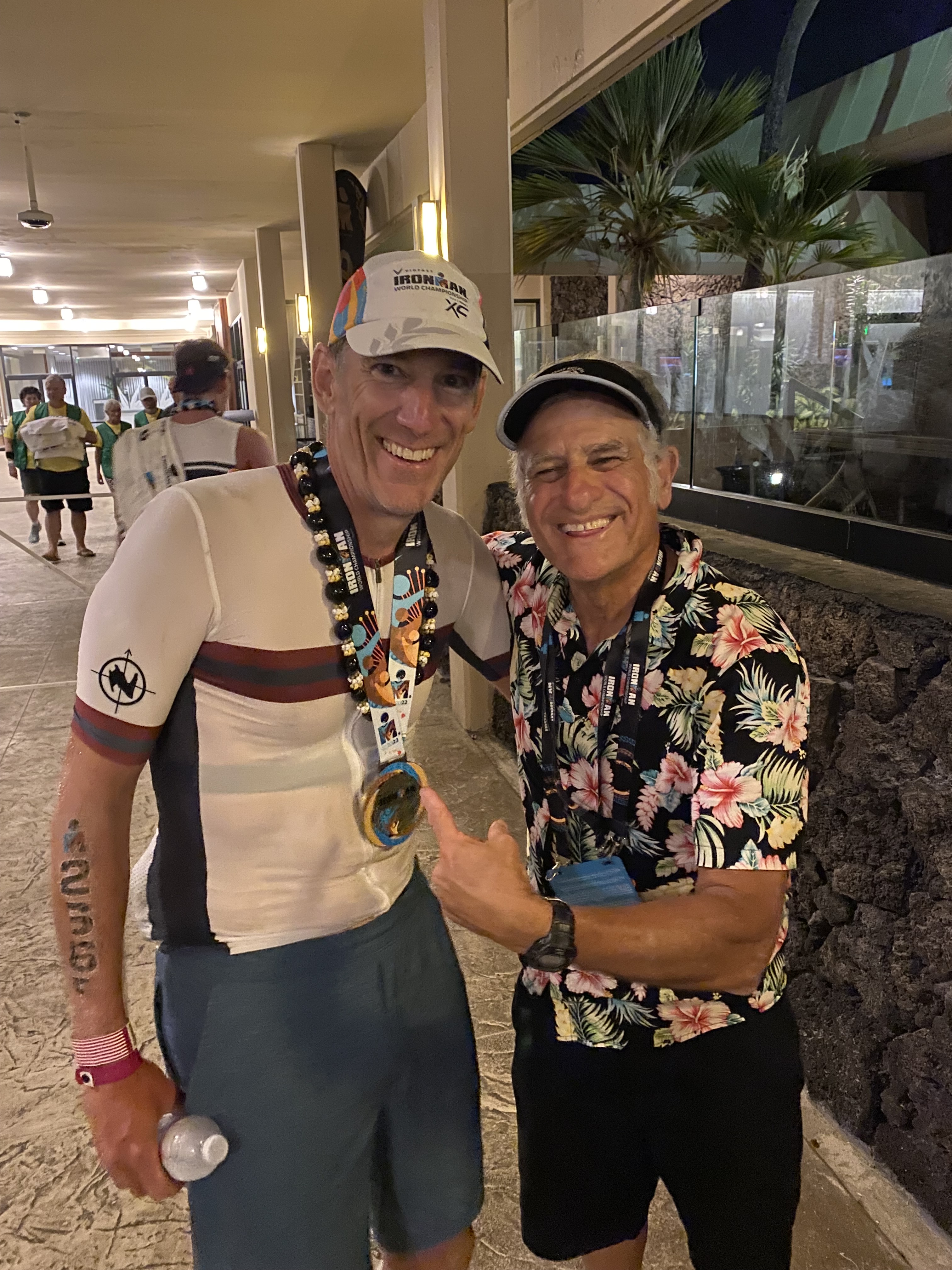
Yes – Bob Babbitt stopped me to offer congratulations! I had to decline doing “Breakfast with Bob”

There was one thing left to do! After grabbing a cold piece of pizza, taking two bites of an Eskimo pie (yes they were offering ice cream sandwiches), two sips of sprite, it was time to shotgun a beer with Austin. All week we had talked about this celebration and now it was time to deliver. We had planned to do it at the front of the hotel in front of the athlete name wall. On our way there, I met up with Bob Babbitt who gave me a congratulatory pic. We got to the spot on the wall where my name was and unfortunately an athlete was laying in front of our spot – so we asked him and his wife to move!  Austin carved out our holes in the Stella cans, handed me mine and said the tradition is to shotgun on one knee. I took two, and then we popped the top and the beer flowed. I have to say, that while I lost, I put on a good show and the beer stayed down. Of course, I then dropped to all fours – my ironman day complete.
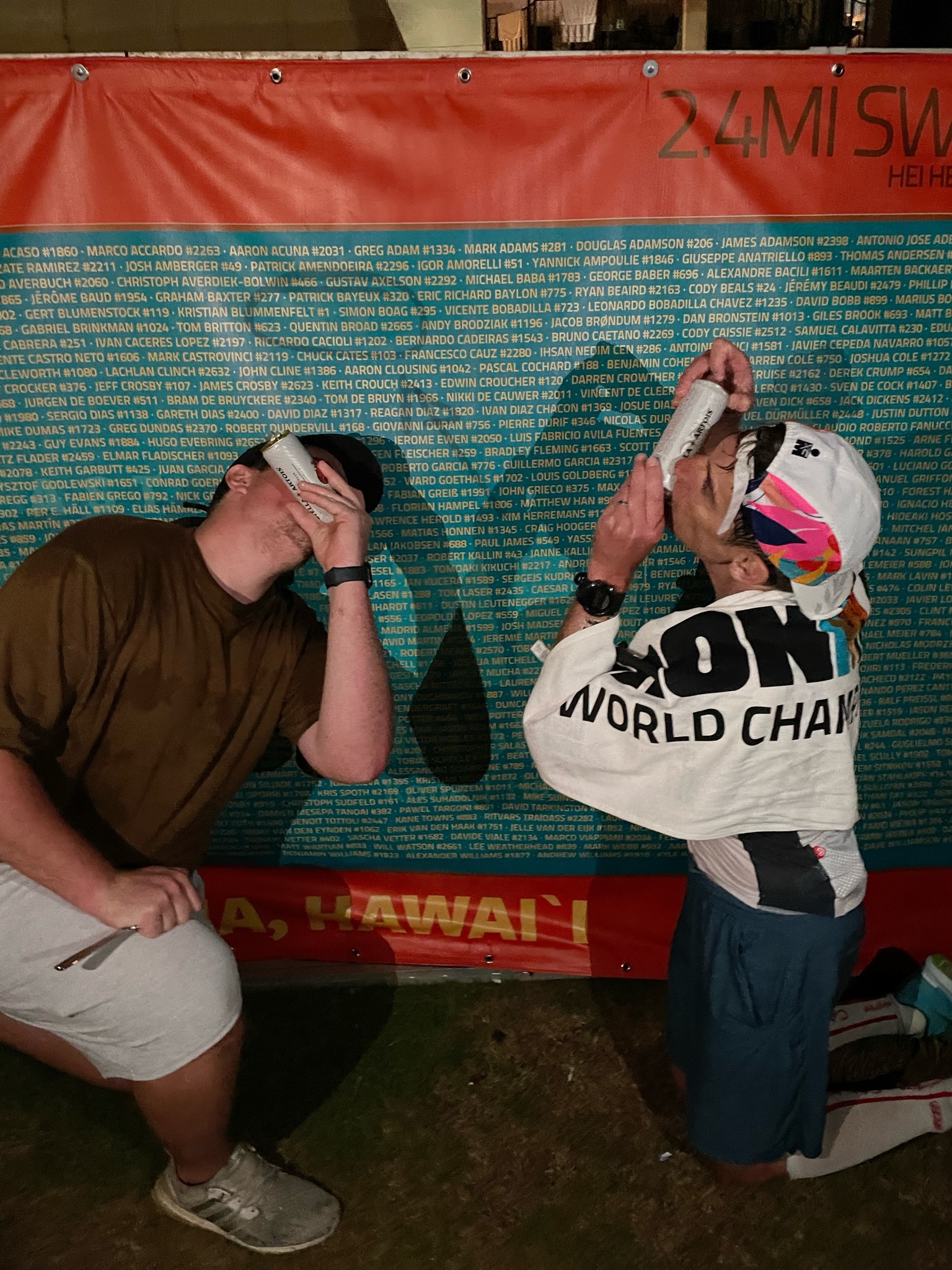
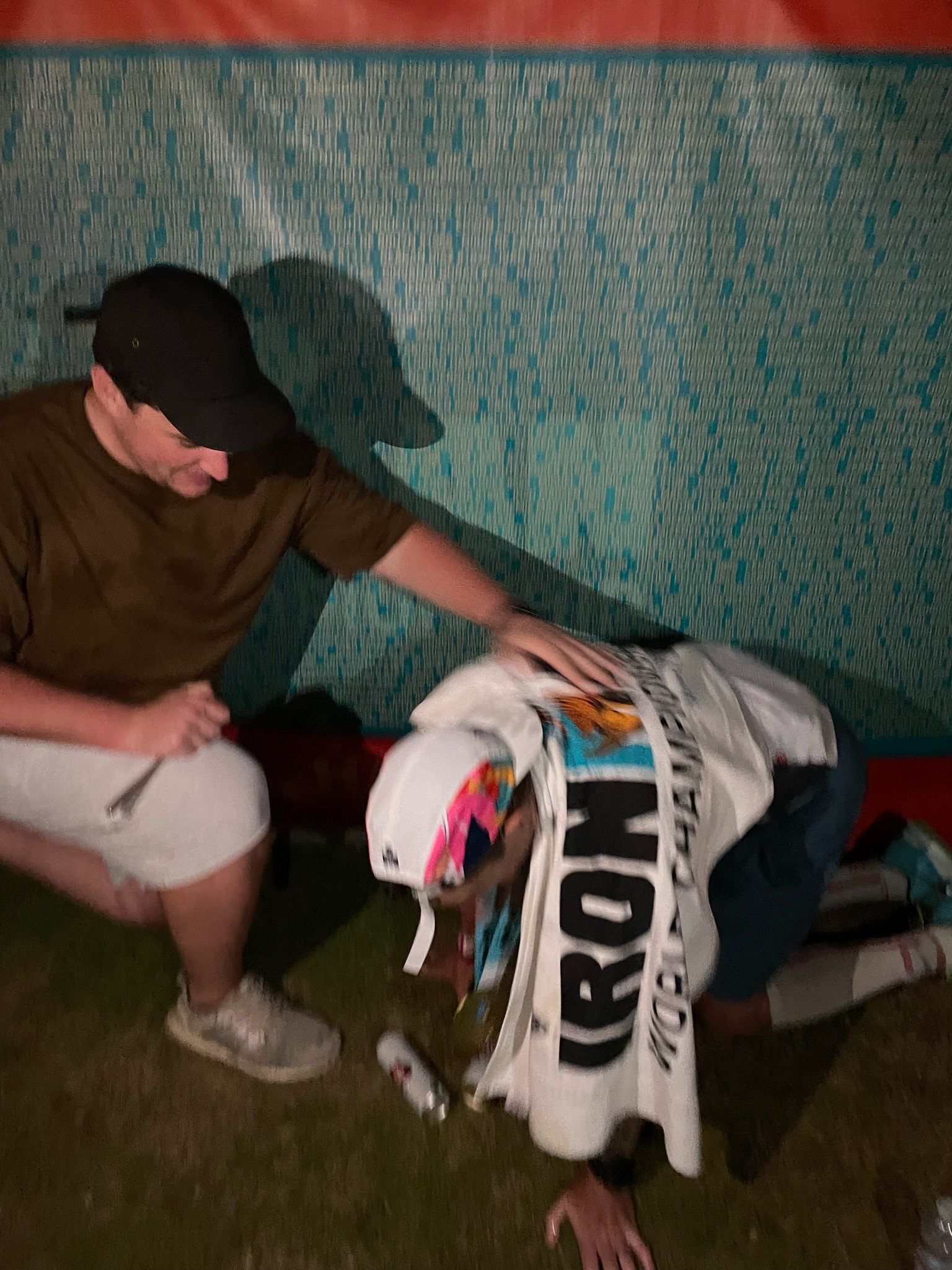
Shotgunning a beer with Austin brings the Ironman World Championships to a close.
Ok Now it is Over!
Fresh as a daisy.

Ironman Lake Placid – Classic Course, great fans – 2013

17 Oct

Ironman Lake Placid Race Report

Well it is the early morning after the big day and this is always a time of reflection about the months of work that I put into the pursuit of finishing an ironman. Good news, I completed IMLP as it is known. Better news, I achieved a personal best at 11:33:28 by 8 minutes over Ironman Canada. Both of these courses are considered to be tough by Ironman standards and so I believe this truly is a pb. In rough terms, I had a 1:15 swim, a 5:33 bike and a 4:33 run – the rest was spent resting (as Stew McGuire would say) in transition.

Each time I race one of these events, I always come away humbled. The effort of training never seems to be quite enough to prepare me for the challenges that will exist out on the race course. Yesterday was no different. Here is the backdrop to my day.

The good news is that I got to race day without any major injuries, training went largely according to plan, a lot of time spent on the bike and running, far less so this time around on the swim. If anything remains clear, i love riding my bike more than I love running. Having said that, one of the things that I implemented in my training was running to work in order to fit it into my day. This will probably remain a part of regiment post ironman training. A great byproduct of this craziness. 

For race week, Maddie and Dianne joined me for the journey down to Lake Placid, we left early on thursday morning and made the 7 hour trip to our hotel. A great place for anyone planning on attending this race – Whiteface Lodge, pricey but they take great care of you. This was supposed to be a mini vacation for Maddie and Dianne, of course always a challenge when your dad/husband is preparing for his race. We managed to get in a number of activities around my preparation, all captured by my daughter’s list.

Friday morning I wandered down to the lake to get a swim in. The air temp was 8 celsius, the water temp much better at about 20, so lots of steam coming off of the lake at 6:30 in the morning. At placid there is an underwater buoy line that marks the race course, negating the need for sighting. Having said this, no doubt that this will be a busy place on race day. I got in a good warm up swim, putting in about 2km, feeling very good. Following the swim, I went back to the hotel and had a great breakfast buffet. The plan for the rest of the day was a trip to the bobsled run (Dianne hurtled down the course in 43 seconds – not bad for $70!!) and then a reconnaissance of the bike course and then fit in some of Maddie’s activities (shopping ). For the bike course, I had heard that the descent into Keane was ripping fast but that the road could be quite treacherous, bumping and grinding you all the way down.  While I am very confident in my own bike handling skills, it is always a worry about those around you not holding their line, particularly if the wind is up or the ground is wet, the latter was fully expected. I took the descent as quickly as was reasonable given I had to hug the right side of the road, on race day we would be given three lanes to work with, making the descent much better. After this segment, I jumped back into the car and we drove the rest of the route to mile 40. This is the point at which the climbing back into Lake Placid begins. I wanted to get a good sense of how I would be managing my watts. My goal was not to push through 280-290watts for any sustained period. During this test climb, I found I was able to maintain a reasonable speed, while aero and not pushing the watts beyond my target range. Check. During the rest of the day, Maddie and I went fishing at the little pond they have out back, she swam in the pool and then we made smores over the campfire. 

Saturday morning I went out for a nice run around Mirror Lake. As has been the case since Welland, I have been running 2kms and then taking a 1 min break. My plan in IM was to run 5:30-5:45/km and then have the rest after 2 sessions, believing that I could manage to convince myself that 2 x 1km segments were easily achieved. Everything felt good, no stress. The rest of the day we used to check the bike in, do some fishing with Maddie, some more shopping, we watched a movie in the cinema at the hotel and even used their bowling alley – as I said, a great place to stay. For the bike check-in, I was not thinking and instead of putting my bike and run stuff in a plastic bag within the transition bag to keep everything dry (given all of the weather reports said rain was a given over night and on race day), i simply put small holes in the bottom of each bag to allow the water to drain out. We had an early dinner in Saranac, decent family italian restaurant, ate whole wheat penne and chicken.  Felt good on race day eve.

Sunday morning – I had set the alarm for 4:15am and a wakeup call for 4:30, didnt need either as I was up at 4am. Had my usual breakfast of Vector, some OJ, banana, and some coffee and then got regular. Given there was no rain over night, I put out some plastic bags in order to do what I should have done yesterday and repack my transition bags when I got there this morning. Weather reports still were suggesting that at least 2-3 hours of the race were going to be done in the rain.  I gathered Maddie and Dianne and we drove the back route to the race site that we had carefully plotted out and found a parking spot 5 minutes from transition. At this point, despite being a 3 time ironman, I was to prove that i am still an amateur. I got to my bike and pumped up my tires. Good news was that the tubes didn’t blow during the heat of Saturday (wasn’t likely but is always possible – right Stew). I filled my aero bottle with my eload+carb mixture and put my concentrated bottle (equivalent of 4 bottles once mixed with more water – a first time experiment for me) on the bike. As I walked back through transition taking note of entries and exits again, I realized that I didn’t have the plastic bags with me – stupid! Worse still, I had left my special needs bags (for the bike and run) at the hotel – stupider! Oh well, I have not used the special needs in the past, except in Austria and that was a disaster. Having said that, I did not have enough room on the bike to carry all that I wanted (nor do you want to lug the weight around) so I had planned to pick up round 2 of nutrition at the special needs. This time i had made PBJ on Hawaiian bread rolls (great tasting and 240 cals for each one), other than at the Tour of California, I had not raced with these but thought they would break the sugary gel load.

 I left transition and found Dianne and Maddie out on the road, after being body marked, I put on some sunscreen, not expecting to need it, but not wanting to be burned if the weather man was totally wrong – and then waited. Dianne had suggested that she might go to the hotel and pick up the special needs bags and drop them off, which would solve my problem. I told her not to worry about it. The excitement was building, the swim area was a throng of athletes and spectators. 

 The swim:

I got into the water about 10 mins before the pros started, simply to get wet and ensure my goggles were sealing – check. For the second race since announcing changes, this was going to be a “time trial” start where they would send us out in waves of 100 or so, self seeded by time. I put myself at the back of the 1:10 group, feeling that this would be a quick time but doable. While standing there Jodie Ferneyhough joined me, funny in the mass of 2500 athletes, the two BCCers were going to start together. At 6:30 they sang the national anthem and everything became real, ironman 4 was about to begin. Within about 10 minutes we were into the water, the kicking, shoving and slapping began in earnest. While much more manageable than the mass starts that have been my Ironman experience till now, there was still lots of action. Frankly I have to say, the women are the most aggressive in the water, as everytime I was thrashed by kicking, I would look up to find a pink cap in front of me. In any event, the swim went reasonably well, loop 1 had a couple of occasions where it bunched up and it was difficult to find open water. I was staying relatively close to the underwater line, which likely meant I was going to be in for more contact as people fought for this line. I came out of the water after the first loop in a very tidy time of 35 minutes, faster than projected. The second loop was a little less chaotic and this time I wasn’t getting on as many feet as I did on the first lap. As a result this cost me about 5 minutes of additional time – i probably also settled in a little bit more. I always think of the swim as the mere price of entry to completing an ironman, do it fast if you can, but just get it done. Official time out of the water 1:15, this put me 121st in my age group and 969th overall, clearly not Michael Phelps!

Transition:

coming out of the water, they had the wetsuit strippers available immediately, so quickly that I hadn’t actually unzipped myself. After a little bit of wrestling, they finally got me out of my wetsuit and I started the 300m jog to get my bike. As I ran down the chute, I was looking for Dianne and Maddie in the hordes of people hoping I would see them before leaving for the next couple of hours and they didnt disappoint, standing right agains the barricades before transition. I stopped and gave both a hug and kiss – now I was on two round two. In my mind, my strongest part of the event, but this year I saw it as simply the precursor to the marathon – I wanted to have the legs to complete a reasonable IM marathon. Nutrition – 1 gel and half bottle of water

The Bike (2 loop course):

I changed with reasonable speed but nothing earth shattering. I decided to ride with a vest and arm warmers, I used the former to carry food and I probably didn’t really need the latter, but they weren’t a bother. As I came out of transition on the bike it started spitting ensuring that a more conservative approach to the ride was in order. There is an immediate quick short descent out of transition with bales of hay at the bottom of a sweeping left turn. The idea was not to HIT THE BALES OF HAY! check. As I got past this dicey little part, I started to take inventory of how I was feeling. The stomach was good, the legs felt strong, the butt felt good and my mindset was good. I then took stock of my electronics. I had put my old garmin 310xt on the bike with the sole purpose of showing me my watt output. My 910xt was on my wrist, to take me through all 3 events in triathlon mode. Everything had worked yesterday like a charm, and so there was a bit of panic when I saw that the watt screen on the 310 showed nothing! Hmmmm, no issue, maybe it just hadnt picked up the power stages meter yet. So as I was riding, i began scrolling through the screens in order to pair the power meter with the 310. Hit the “pair the device” button, here the beep that pairing is successful – great, I can ride with power again – NOT. The screen was blank. No issue, maybe it is just the 310 acting up, it is why bought the 910 in the first place. Scroll through the screens, no power. Ok, pair the device, get the beep, no power!! WTF, I have done all my training with the express purpose of riding this course to a prescribed watt level. I went through last minute jumps through hoops to change over my crank so that I could use my stages crank with my race wheels instead of my power tap on my training wheel. AND NOW Nothing is working. Ok settle down, this isn’t my first rodeo, I will ride by heart rate, speed and perceived effort. I had expected that my 235 watts planned output should have delivered a race time of 5:20-5:30 if I was able to maximize my aero position. Now I will never know. For me the bike is fun, I am able to reel in rider after rider, rarely giving up position to anyone and this was while keeping myself under control. The first 45 minutes on the bike, give you the opportunity to start the nutrition process given there is some modest climbing but nothing to challenging. The descent into Keene would be great fun on most days but with the rain, I put more caution into the ride, although still hit 71.4km/h on this descent with an average speed that was closer to 60km/h. What I didnt realize given we drove the next part of the course was that once we “bottomed” at Keene, the course still descended modestly, allowing me to maintain 40+km/h with a heartrate of 140-145, everything in check. I took the opportunity to take in some PBJ, a gel and taking on liquids. Until we get past Jay (there is an out and back there) the course is relatively flat and boring, turn the pedals, take in nutrition, pee if you can and get ready for the climbing that will be the last third of the course on this lap. The climb to Wilmington is probably steeper than the climbs back up to the race start. I focused on just providing a steady output, if I had power, my guess is should have said 280-290 watts, but I will never know.  Past the short out and back in Wilmington, we begin the climb of 16 miles into Placid. The general bias is an unrelenting move up with probably 2-3% grade until you get to the 3 climbs within the climb – Mama Bear, baby bear and the Papa Bear. Here people line the climbs cheering you on. Here you climb from 300m to 600m in about 20km. Again I just kept my focus and didn’t get carried away trying to reel people in. Once past the climbing it is a fast 5km run into placid itself with people lining the course screaming at you. As I rounded the last corner I pulled over to pick up my special needs bag and get my next two PBJs. Dianne had taken me for my word, they didn’t have my bag, oh well, I will survive! Lap 2 was much the same as Lap 1, only this time there were a lot fewer riders on the road. While I wasn’t focused on time, I knew my pacing would be putting my in the top 20% of riders meaning I was now catching or distancing myself from those who came out of the water ahead of me. My first lap took about 2 hours 40 minutes. As I came through the start area, I wondered where I would see Dianne and Maddie and I didnt have to wait long, as I rounded the first corner past the start area, there was Dianne with her signs screaming at me. I stopped gave her a kiss, and got a slap on the ass from a race official!!! The next 90kms was simple, focus on getting good nutrition and hydration (pee at least once – check), keep the legs turning at a good cadence (no cadence meter – given it is embedded in the stages crank, which wasn’t working) so that they were not exhausted for the run – it was all about setting up for the marathon. I figured my pacing was solid and I could afford to back off a little bit. While my times dropped I felt good coming in off the bike. Total Time 5:33 a good result. I had now moved up to 24th in my age group and 223rd overall, which means that I was 16th in my age group on the bike. 

Nutrition had 4 PBJ sandwiches, 5 gels and 5 bottles of eload+carb and 1 bottle of water. Ideally, I would have added 2 more sandwiches.

The Run:

My nemesis, but it was something that I was setting up my entire day to complete. Since my disaster at Welland where I posted a horrific half marathon, I was hell bent to change this experience. In training, I had decided to change from “run for as long as you can” to “run for 2kms then walk for 1 minute.” My goal was to post 5:30min kms which were then followed by 1 min of brisk walking that covered about 110m. If I did this 20 times I would post a marathon of 4 hours – a real achievement in my view. I figured that negative self talk (i hope everyone goes through this!) could be overcome with you can run for 2 kms, then you get to rest.  And so my marathon began. As I came out of transition I began looking for Maddie and Dianne and once again they didn’t disappoint. Resplendent in their pink t-shirts with Team Q – 2244  they were waiting for me with big cheers and signs. I stopped for hugs and kisses and off I went. The Lake Placid run course is a fair one except for the last climb into town that you do twice – however, as you leave town the downhill is huge and while on a bike it is a time for massive speed, running can be a challenge. For the next 13 miles I stayed very close to plan, the best start to the marathon of any of my 4 ironmans. I had a bottle of eload+carb in my hand throughout the run and 1 eload gel I took at 40 mins (1 had 1 gel in transition). As I came through the start area to begin my last 13 miles I started to feel some sluggishness and a little lightheadedness, nothing surprising. Dianne and Maddie were there again cheering my on, Dianne told me I was well on plan.  I stopped for another round of hugs and kisses and began the descent out of town. On a number of race reports, they talk about how this is where the race really begins and so it was for me. My groin started growling at me at about 24kms, not a good sign. This is where training doesn’t really help you because in training you stop as you don’t want to become seriously injured, only becoming race hardened helps figure out how truly hard you should push. The next 14kms would be nothing more than arguing back and forth with myself about my ability to run, jog, walk quickly, walk slowly, just don’t stop putting one foot in front of the other. On this I can say that except for 1 pee break I delivered. I got myself back to the massive hill climb back into town and while I didnt really know my total elapsed time, I knew I was well past breaking 11 hours and the only thing I had to fight for was my PB at Ironman Canada of 11:41. As I got to the top of the hill, once again my support crew were there for encouragement. Some more hugs and kisses and this time Maddie escorted me by running “along side” me – ok she only had to walk quickly! Dianne told me that she would see me near the finish line. One nasty of IMLP is to take you past the finish line on an out and back of 2 miles before the finish line. There are huge crowds lining the streets yelling out your name and encouraging you to run. I tried but man was it tough to do more than shuffle. The interesting thing is how that all changes with less than a km to go. As I made my way back to the Olympic oval and the finish line, I could see by my position relative to the swim start that I was now less than 1 km to finish. The adrenaline started to kick up and my cadence quickened. By the time I came into the Olympic oval I was running again, with a huge smile on my face, trying to find Dianne and Mads in the crowd. I rounded the final corner, hearing Mike Reilly calling out the names of newly minted ironmen and then I saw them standing right at the barricade, about 50m from the finish line, BIG Smiles – I had done it, Dianne and Maddie were screaming at me, I heard my name Quentin Broad, YOU ARE AN IRONMAN, but I stopped short of the finish to give them another set of hugs and kisses, then crossed the finish line in 11:33:28 with a 4:30 marathon – respectable, but still not first rate. 

I finished 47th in my age group of 329 who started (losing 23 positions from when I got off the bike) and 435th overall out of 2,536 competitors.

Post Mortem

Ironman is a humbling experience. Each time I do one of these I am amazed at its ability to bring me to my knees. I always believe that I can do better than what I achieved never quite believing that I left everything i had on the course. I am not sure whether this is a defence mechanism or the truth. The challenge of ironman is evidenced on race day, but it is all the effort in the 6-8 months leading to the event that is the true challenge. I can thank my family who make all of it possible. They have been very supportive in allowing me to pursue a sport which takes a lot of training time, some of which definitely comes out of family time. I love the sport, the culture, the focus, the energy levels, and the impact it has on my body. Being able to compete in Ironman is a tremendous luxury, thank you Dianne for being an enabler for this part of my life. 

Ironman France – challenging bike and heat – 2011

17 Oct

Ironman France – 2011

Ironman France is in the bag – not wonderfully in the bag, but completed nonetheless. This was tough one, but they all are – this is Ironman, but sometimes you just keep wishing it was a lot easier. The key details are as follows:

  • 2,319 competitors went to the starting line at 6:30am on June 26th, a brilliant day that was expected to be full of sunshine and temperatures that would be 26-28 degrees Celsius, hot, but not as hot as previous years! Only 2,058 would post a finishing time.
  • Interesting to me, there were very few women in the race, only 182 went to the start line but the ones who were competing certainly knew how to climb mountains!
  • There were 355 men were entered to compete in my age group, 263 finished the race and I finished at 125th or 1,102 overall.
  • During the race, the competitors consumed
    • 30,000 liters of water
      7,000 PowerBars
      15,000 PowerGels
      15,000 liters of energy drink
      1,000 kg of bananas

As usual, to bring the race report to its crescendo, I finished in an official time of 12:40:56. To put this in perspective, it is almost 2 hours better than my first brush with Ironman in Austria in 2006, where I finished in 14:26 and almost 1 hour worse than my PB at Ironman Canada in 2009, when I finished in 11:40. In terms of timing, I have provided my garmin times against my pre-race plan (which appears to be more of pipe dream in hindsight!!)

Swam 3.8 km in 1:11; plan was  1:08 – ok considering the full body contact in this race

Bike 180 km in 6:07; plan was 5:35-5:45 – disappointing but a tough bike course

Ran 42.2km in 5:10; plan was 3:45-3:50 – demoralizing, hell, hot, painful, why do I do this??

Let me now put some context around the race, to give you a little better feel for my personal journey at IM France. For those of you who ride or compete in triathlons, hopefully the devil of the details will be interesting to you, for everyone else, I apologize for the report’s length and its detail – you could probably stop right here and feel like you have a sense for my day – very tough, just like ironman should be. It is painful for everyone out there, no matter what their times. It is a great sense of accomplishment although every one of the 42.2 kms of the run, I questioned why the hell I do this to myself. I love the training, I love the discipline of training, I love the fitness involved, I love the positive impact it has on my fitness, I love competing – I hate the pain of Ironman! Thank goodness Dianne was out on the run course, cheering, egging me on every 5 km because otherwise I am not entirely sure I would have been able to hear those magical words –

“Quentin Broad, you are an Ironman”

at 7:10 pm on June 26, 2011 in Nice, France.

 Now the Devil of the Detail for those who have an interest (be forewarned this even longer than my  usually verbose blogs):

 I arrived in Nice on Wednesday night and managed to find my way to the “youth hostel hotel” as my wife calls it – Hotel Ibis, about a 15-minute walk from the starting line. Now perhaps knowing better, as my fine friend Milt Bonellos does by competing in his 3rd IM France, I should have booked the Meridien, which is located right on the start/finish line of the race – one of the best places to view at least half of the race (stay here on floor 4-8, rooms 00-10 even numbered if you are planning to race IM France).

 Thursday morning I had planned to register, drive the bike course during the afternoon and then join up with Milt on his arrival Thursday evening. Unusual for Ironman, the Expo was empty when I showed up 10 minutes before its slated opening time of 10 am, so I waltzed right in at the stroke of 10 am and was registered in under 15 minutes. A couple of things about IM France. They request that you have a “one-day” racing license and if not you must bring a medical certificate signed sometime in the last 60 days and pay 30 euro. If you have no medical cert, of course they will have a doctor on site who will also charge you 30 euro to stamp your clean bill of health. Well, for those contemplating competing in the future, I would suggest that you just bring your USAT card or even your OAT card, and save yourself $42.00 – as they didn’t check my med cert, but certainly were looking for the money. Thursday, Friday and Saturday, largely flew by as I hung out with Milt waiting for Dianne to arrive as she went through her own travel hell just trying to get to Nice. We did some pre-race swims, which would prove useful only insofar as I had never competed in salt water. However, with no buoys to define the race course prior to race day, figuring out what sighting would be effective was useless. He had lots of pasta, kept well hydrated and tried to stay off my feet.

 Race day was the usual mix of emotion. Dianne and I planned to leave the hotel at 5:15 am to get to the race site at 5:30 where we would join Milt (of course he just had to waltz out of his lobby and he was at the start line). Some of the many challenges of racing in another locale, let alone another country that is an 8-hour plane ride away is ensuring that you can stick to your routines. I got to bed around 9:45 pm, but mostly rested, not sure how much you really sleep before one of the these races. I had asked for a wake-up call and set my numerous electronics for various times, 4:15 am being the first wake-up. Unfortunately, finding breakfast at 4:30 am in any place is tough. Having your breakfast that you would normally prepare at home in advance of a big ride or run is also made difficult when you are staying at the Hotel Ibis. With no fridge, no coffee maker, kettle, microwave etc., I was left to my devices to create a breakfast. On Friday, I had managed to pilfer a plastic bowl from the pasta party and used it to make oatmeal I brought from home, mixing in warm tap water – YUM! I then managed to down a banana, and put together a small baguette of PB and Jam. Key for me, however, was no coffee – I always drink a coffee – preferably a Timmies – before the big workouts to get things jump started, but not today. I filled my bottles for the bike, they were premixed with the eload carb, electrolyte adds, and the powerbar perform. I made three up, one for the aero bottle and the other two for my cages. In hindsight, this was a mistake, at most I should have had just two filled with water and probably could have gotten away with just the aero bottle filled. The organization of the feed stations on the course, makes it easy to keep weight to a minimum and just substitute out bottles when you need them, keeping things light for all the climbs.

 We walked down to the transition area and met up with Milt. Things were hopping already, with the race still an hour away, they began warning athletes that the transition area would be closing in 30 minutes. Of course, all I needed to do was drop off my bottles, and add air to my tires (hoping that I had taken enough air out the day before so that they hadn’t popped while sitting in transition on Saturday – why leave any air in you say? So that I know if they popped or have a slow leak, then I can fix them before the race begins!). So after some hello’s, how did you sleep, how was breakfast etc. Milt and I went to find our bikes. When we racked the bikes the previous day, I was very lucky to be situated in a row where the light standard above had two of its three lights missing. Since this was a 500-metre-long transition area (a very long transition zone, in my experience), and there were 15 light standards in total, this proved to be a key landmark for me since I was able to quickly locate my bike as I came out of the swim. In shorter distance triathlons, it would also enable you to rack your bike quicker on the way in from the bike portion, but in Ironman they do the return racking for you.

 Hmmmm,….I am standing right in the area that I left my bike yesterday afternoon……where is my bike????….. Announcer: “Athletes you have 20 minutes to clear transition”, no problem, lots of time, I look one rack over to my left, I look one rack over to my right – no bike!! WTF is going on? I keep staring at the bikes in front of me, checking them again and again – that is why I put red handlebar tape on the bike, so it sticks out. Nope, none of these are mine. I start to lose it a bit and return to the light standard to get my bearings. Nope, still no bike. I figure I should find a pump while I am noodling where my bike might be, so I flag a woman down who is standing outside of transition with a pump and ask in English if I can borrow it. She responds in French something about her husband needing it while pointing at him. I go talk to him and he tells her it is ok so she hoists it over the fence. I now start trying to figure out my bike riddle. I start scanning the bike numbers trying to figure out where it should be given this is supposed to be in numeric order. Announcer: “athletes, you have 15 minutes to exit transition”. OMG, as panic starts I get to the other end of the row to find my bike exactly where I hadn’t left it (they had reversed the order of the rack, or the first rider to have racked his bike put it in the wrong end the day before)!! I check the tires, they held air so I started pumping quickly, pushed in 120psi, threw the bottles into the racks, and filled the aero bottle. I turned to give the pump back to the women and I see her walking away from the fence – Announcer: “Athletes –10 minutes to exit transition”. I start yelling at her in my best French – hey mademoiselle, mademoiselle, le pump. She isn’t listening, what else is going to go wrong. Finally my yelling is heard and she stops, looks at me and sheepishly comes to the fence to take her husbands pump. Whew, Announcer: “Athletes –5 minutes to exit transition.”  As Stew McGuire would say, “See, tons of time to spare”. I exit and find Dianne and Milt waiting just outside transition. At this point I need to have my daily constitution, so I make my way across the street to Meridien, use the facilities and return to get the wetsuit on. I give Dianne a kiss, we get a photo of Milt and me and begin the descent down to the beach for the start of IM France.

 For those of you who have not been to Nice, it’s a gorgeous city, abutting the Mediterranean. You descend a long ramp to the rocky beach (not much in the way of sand, just huge rocks or big pebbles – ones you would have no chance of skipping on the water). Unusual for the 3 races I have competed in, IM France creates corrals based on expected swim times. The pros are located right in the middle with times expanding to the left and right of them. I choose the 1:06 corral (I was targeting 1:08) and slipped through the group to go frolic in the water for 5 minutes. I managed to get 50 metres of strokes in before they started calling the swimmers in with 15 minutes to race time. The course had only been set up that morning so we had not had a chance to see the race course in any of the practice sessions, so there was a lot of talk in the corral of exactly where we were going. It seemed logical to me, so I just focused on my game plan and didn’t get caught up in any chatter.

 At exactly 6:30 am, the gun went off and my long day of IM France began – all of the times I have put in this race report come from my Garmin, which is slightly off from the official race times). I will try and post some of the race photos Dianne took on the beachescycling.com blog, the mass of athletes moving into the water was unbelievable when viewed from the shore. The mass of athletes when viewed from the middle of the washing machine was even more unbelievable. In my 3 ironmans, I have never had the body contact that went on in this race. There was no place to go, you moved as fast as the person in front of you unless you got real aggressive and tried to push your way through the bodies (sidebar: much is said about getting in open water swim practice – I believe it is almost useless for ironman swimming – it is quite useful for wave starts, but with the mass of bodies, the churn of the water – which makes anything other than the breast stroke ineffective for sighting – it seems to me you just keep swimming in ironman, bilaterally breathe and make sure there are people on either side of you. If somebody all of sudden seems to be cutting in front of you almost diagonally to your current course, then check to make sure he’s going in the wrong direction not you). The first loop of this course had 3 turns over 2.6 km, then an exit from the water and then another 1.2km swim with 2 turns. The congestion never ended, at each turn it was like the gardiner expressway at rush hour with a 7 pm Leafs game – lots of irritation but nowhere to go. Throughout the battles, I had to adjust my goggles about a dozen times as I was getting smacked and kicked and was taking on salt water. I couldn’t see effectively given the salt irritation, so I just kept pulling into a breast stroke / treadwater and try to get them back on with a good seal. Notwithstanding the craziest ironman swim ever, I came out of the water just 90 seconds behind my goal time split. I went back in for the remainder of the 1.2 km and I was able to finally find some sort of rhythm only to have it crushed at the first turn, returned for a bit and then was thrown off from the second turn through home. I got out of the water and my watch seemed to say I had produced a 1:11:27 (garmin) swim, a good number given the experience in the water relative to my expectations.

 Now for the bike – one of my best disciplines. I had told Deirdre Casey (my coach) that T1 (or the first transition) was going to be a long one. As I mentioned earlier, the transition area was huge, I estimated almost 500 m of length in the bike corral alone, not to mention the run up from the beach. Then I wanted to ensure that I was slathered in sunscreen given I was going to baking for at least 9.5 hours (or more!!) and figured skin cancer is not a good outcome. It took me 6:34 to get through transition, which I think is ok all things considered. You could possibly shorten this by 2-3 minutes.

 I jumped on the bike and began the longest leg of the ironman race. The first 10 km of the ride I was getting comfortable, took on a little bit of hydration and spinning quite effectively. My average speed was 37.3 km/h, my average power was higher than it should have been at 240 watts and cadence was 95. Heart rate was elevated at 154. This is a fairly flat, to slight uphill as we exit Nice going toward the airport and then divert towards the wondrous mountains. My second 10k was flowing nicely also, the muscles were getting into the rhythm, I began taking on some food, with a gel, and keeping the hydration going. We made our way up a short 500m steep 12% grade climb, which marked the beginning of the hill work – not really the beginning, but a taste of what is to come – this little test signals that this course is different than the others! My average speed had dropped to 33.8km/h, watts were still 238, cadence at 95 and heart rate was down to 151. I felt good, execution was probably a tad aggressive – in hindsight, I may have killed my effort by what appears to be too high a watt output.

 The hills (mountains) start at about 20k, through to 70k, with rolling terrain from 20-50 (net flat I believe) but the piece between 50 and 70 is a killer 20km climb up to the col de l’ecre – a peak of 1,120 metres – 3.5 times (ish) the height of the CN Tower. My pace was beginning to reflect the changing nature of the course as it dropped to 25km/hr, but watts were firm at 242, cadence had now dropped to 90rpm, but that was still in my tolerance to spin as much as possible. Heart rate, was high, not a good sign at 159, I needed to start backing things down or blow the engine. From 30-40km, I dropped the watts to 214, mostly because I felt I shouldn’t have been where I was and because we had more downhill than up. I managed 30.6km/h, 92 cadence and the heart rate had settled down a bit to 154 but the goal was sub 150. My eating and hydration felt really good. For readers of my IM Austria ordeal, you will note that there were no upchucks on this ride, and I managed to ingest pieces of banana at almost every aid station in addition adding a gel almost every 40 minutes or so. The next 10k saw me hit 40.5km/h average speed as I was taking strong advantage of the descent opportunities, getting into my drops and being as aggressive as possible without putting my bike off the edge of every cliff. Cadence remained perfect at 91, watts had slipped to 208 and heart rate was now on my 150 high end target. Through 50kms, the course had been a delight, some good climbing relative to Ontario roads, excellent quick, twisty descents and even some in the aero bar flat road. Through 50kms, I had taken about 92 mins or an average speed of 32.6km/h – right on target for the 180kms!! Piece de Gateau!!

 From km 50 to km 70, IM France took aim and fired – I wilted. For the first 10kms of the climb my watts dropped to 218, not bad for a flat road, but the mountain began eating me up. The heat was starting to take hold as we moved from morning sunshine and lots of tree canopy, to a higher sun and fewer trees. My heart rate was now 161 and my cadence was dropping and averaging 78, I couldn’t keep things spinning with the gears I had. Speed of course, as an outcome of these inputs, fell to 16.5km/h. No problem, I say to myself, as a 3 time racer of IM France, Milt suggested that the last 110kms is almost as fast as the first 70kms – so just grind it out QB, you can then use your aggressive descent skills to make up time. Well the next 10k certainly doesn’t get easier as you race to the summit. Skinny short people, skinny tall people and even some not-so-skinny people are passing me left and RIGHT (the ones passing on my right I keep yelling at to pass on the left). At this point, I harken back to Chris McCormack’s book (a must read for any triathlete or cyclist for that matter) and on page 110 he says; “at 177 pounds (that is what I weighed on the IM France start line!!) I am way too big to race Ironman France (now remember this is one of the most vaunted professional triathletes to walk the earth – just ask him!), they would have to pay me a hell of a lot of money to go there because I just can’t climb with those little guys – its just physics, I weigh 177lbs, they weigh 130lbs”. 10kms at an average speed of 14.5km/h takes a long time. My watts had dropped to 197, but my heart rate had remained elevated at 159. My quads had now begun their major protests. Every time I tried to stand out of the saddle they would screech, I would then sit back down and they would spasm, first the right, then the left then both together. It was like they were playing a symphony of pain. I kept chanting David’s (my yoga instructor) admonishment, keep breathing, this isn’t about being physical, keep breathing! That works for yoga, it wasn’t working so well for the hill climbing. I kept sipping my electrolyte drink thinking maybe I was out of sorts given every athlete that I had gone by me had “white” shorts on (sidebar: when you are cycling at 14.5km/h, you get to study very closely and for much longer periods than you would like – everyone’s butt and by this time, almost all of them were heavily covered in salt stains). Well the climb to the top of the col de l’ecre, 20kms straight up, had cost me 78 minutes. However, according to Milt, it was easy from here and I was under 3 hours to this point – barely (note to reader – what goes up must come down in a looped race therefore I was going to experience 1,120m of descent. However, coming down this high of a mountain requires a lot of twists and turns, not ideal for making up time).

 From here the race remains a tough test, it is a net downhill for sure, but there are still 3 more climbs to be made and they are not insignificant. I felt that my bike was solid but my legs were telling me that I was asking a lot from them. With a goal time of 5:35-5:45, I was in clear danger of not holding this together, not because of the time I had taken to get to the halfway point of the bike (3 hours 28 minutes) but because my legs were not feeling resilient under the constant climbing, which did not bode well for the run.

 The rest of the ride was slower than I might otherwise have hoped given its profile. This race course is materially different than anything we ride in Toronto, or for that matter what I rode at IM Canada or even IM Austria, which both had large climbs of their own but very straightforward fast descents. What makes these mountains even tougher for a cyclist is the technical nature of the descents and the fact, let’s face it, most triathletes do not have great bike handling skills. Add to this the fact that many were riding tri bikes and trying to negotiate descents in the aerobars and it makes for some tough passing and clogging of the road. This isn’t an excuse, it is a fact. The many turns, switchbacks, cars on the course, narrow lanes, and harrowing falls off the cliff if you miss a turn, all make for more trepidation when descending than I would ordinarily like. I think the roadbuilders might be bike collectors as many of the “guardrails” are 12-18” high stone blocks that would serve simply to stop the bike from going over the cliff, leaving the rider flying through the air with the greatest of ease.

 At this point, my goal is to get this bike done in 6 hours and hope that I have something left in the gas tank to make my way through the marathon. Throughout the ride I have been taking on lots of water, electrolytes (critical that it is not straight water given the salt loss) food, gels etc. The race plan has gone reasonably well except for the timing of the bike but more importantly what feels like a heavier toll than I expected on my legs. At just over 6 hours, I can still reel in a good run and be able to post an 11-hour ironman finish, very respectable and a PB.

 I got back to transition and jumped off the bike, leaving my shoes on the bike (unusual for me but I felt it was the best way to go given the long transition zone). I picked up my run bag and slathered some more sunscreen on my arms, shoulders, neck and legs, very fearful that I was being burned to a crisp. All through my training and I had been doing brick work (this is the name for running right after cycling; for those who don’t do triathlons, going from the bike to running is very challenging, you almost need to reprogram your legs to run). I felt very comfortable making this transition and in fact throughout training I was having to hold myself back in terms of pacing.

 I had planned with Deirdre to do the run on a 5:15-5:20/km pace, which would equate to a marathon time of 3 hours 45 minutes to 3:55 – very respectable. For the marathon at IM France, the runners go from the start area, out to the airport, which is 5kms away along the waterfront and then return to the start/finish line. Each time you come back to the start line, you get a coloured bracelet to take back out with you. Collect three of these bracelets and then you know the next time that you return from the airport you will be running down the finisher’s chute to become an ironman.

 So as I began my last leg of IM France, with now the largest component of the race completed, my concern as I was coming out of transition was how were the legs given the ride and would they hold up for a marathon. Given the time I delivered the clear answer to both questions was NOT WELL and NO. Perhaps the better question should have been how tough was the mind, and was it prepared to handle the pain that was about to be foisted upon it? This was an equally dismal answer, but the development of this story at least took a few kms!!

 Dianne was at the bike transition area as I came in, so I was able to get a kiss and some good words of encouragement! As I left T2, I heard her shout our family’s favourite race mantra from the movie of the same name: “Run, fat boy, run!” And an added, “Don’t embarrass us!” I got the legs moving relatively well coming out of T2, easy to do given this is the finish line for the race and the crowds that had gathered were significant, the music was blaring and there was lots of cheering. The run course is a mixed bag. Fantastic because it is flat, boring given it is an out-and-back loop of 5 km each way. Tough because it is right along the Mediterranean and has absolutely no shade outside of 50 m during the 5-km route. With 28 degree weather, we were certainly getting toasty warm out there and the only respite available was to run under showers that were positioned at each aid station. Of course, if you were doing this, you were going to complete a marathon with soaking wet feet, not something I wanted to do.

 My first km was on a 5:10 pace, a little quick but I knew it would be given the crowds and the desire to get on with things. My heart rate was 148, which was just fine and it would certainly be ideal if I could keep it south of 155, while maintaining pace. Hmmmm….I backed things down a bit in kms 2 and 3, fearing going out too fast would exact a heavy toll. So I put up a 5:15 and then I walked an aid station, and posted a 5:46 ooops, need to get that back. Then a 5:35 and 5:42. At this point I had reached the airport turnaround and was feeling decidedly bad. This is how almost everyone feels, but somehow when you are feeling it, it feels really bad. At this point I noticed my equilibrium was off, a little dizziness and the fact my ears were not clearing. Perhaps the combination of water in my ears and the altitude from the bike, left me with clogged ears, meaning that my breathing was amplified in my head. My heart rate was now pushing 160. I tried walking two aid stations, see if I could find something that give me a jump. I took on some coke, banana, orange, cracker and hit of a gel. I had a pee (at least I was hydrated enough). Nope, nothing, notta. My pace was dropping to a shuffle, the race was disintegrating before my own eyes as I posted 2x 7:48kms.

 This was becoming ugly and we weren’t done 10 km yet!!!! I started hoping to see Dianne, to pick up my spirits and get things moving.  I pushed things a bit, got it back down to a 6:43 pace but this felt like hell and it wasn’t even fast – in fact, as I was running, I thought I was shuffling relatively quickly maybe a 5:40 or 5:45 pace only to look down at the garmin and see how really slow it was. I finally saw Dianne at about the 9-km mark, she yelled out my name, had a big smile and a huge sign for me. I stopped to talk with her and hoped that she might not talk me out of quitting. Fortunately or unfortunately, she just suggested that I should keep going, one foot in front of the other, I could do this.

 The rest of this story is just a painful recollection of km after km of legs telling mind that they weren’t interested in playing any more. Mind telling legs that they only had to get to the third stop light and then they could walk again. Legs telling mind that he was lying about the third light, because now we were at the sixth light. Legs deciding to cramp up in protest, spasms moving to groin area, all my body parts working in concert to get mind to quit this stupid game. Mind praying to see Dianne and getting a boost each time from her encouragement, reminder that I have trained to do this, that I have done this before – twice! Mind reasons that this just makes me insane because the definition of insanity is doing the same thing over and over again expecting a different outcome – pain is always the same outcome of IRONMAN. What was I thinking? Why do I do this to myself? The run/walk becomes a walk/run and for those of you who have done ironman, you will know exactly when this transition occurs because you have experienced it or because you see it in the competitors around you. I managed to get Dianne’s support on each 5-km segment, which at least made this experience a shared one.

 The interesting thing about ironman is you can’t fake it. There are a lot of things that you can deliver in life by going through the motions but this event won’t let you just go through the motions. It demands your respect, it demands that you train your body for what is one of the toughest race formats around. Inherently it demands that your mind is trained as thoroughly as your body for the extended period of discomfort if not pain that you need to deal with on this day. However, the 5+ hours that I got to spend on that marathon course, got me to wonder why I do ironman and will I do it again.  As some of you know, I have put my sights on qualifying for two events; the Boston Marathon and Kona. I have missed qualifying for both three times. Unfortunately, I am very competitive and I don’t quit and while I continue to think these goals are lofty they are achievable despite some race results that might indicate otherwise. I told Dianne during the race that I wasn’t going to do Ironman again because it was just too painful and that while I loved all of the effort that went into getting ready for this event, the race itself was just hell. She suggested that, like any mother during labour who swears she’ll never have another baby ever again, this too shall pass. Thankfully our memory of pain is short so I will have to give this another go. It will need to wait for a bit, and like Macca, I may have to choose my race course a little more carefully, ensuring that it suits my talents, whatever they may be at the time.

Until then, I am proud of the fact I finished IM France and can now call myself a 3x ironman finisher.