The Norseman Extreme Triathlon race report – Race Date August 5, 2017. Simply the Ultimate Triathlon on the Planet.
The readers digest version is quite simple – BLACK T-SHIRT finisher!!! From an official time perspective, the elapsed time was 16:15:06, making me the last Black T-shirt finisher for 2017 – more on the time element of this race and my placement later.


This is what we were racing for!
In its totality, this race is epic, it is extreme, it is beautiful, it is hard, it can easily break you, it builds friendships and it strengthens relationships. The race is like no other that I have raced in triathlon given the importance of your crew – and my crew delivered an A+ outing – thank you Dianne, Corbin and Stew, you ensured that I successfully got to the top of Gaustatoppen. Finally, a big shout out for Greg Gannon, my coach for this effort – his insights, training plan and words of wisdom – “don’t awfulize” the elements, let the race unfold “each piece of this race you have executed before, it is only once the entire race is completed, that it is Extreme”. For those that want to read on, what follows is the long form report that will dive into many of the devils of the detail that went into my successfully completing the Norseman. Of course, despite the length that follows, no doubt I have left many elements of the race out of the report – it took me 16+ hours after all. You cannot underestimate the physicality of the race, the mental punishment and the logistics requirements of a self-supported race – all of which combine to make it extreme. What I am truly thankful for and didn’t quite appreciate during the race is the number of family and friends of Dianne and me who spent much of their Saturday watching the live broadcast, cheering me on and being with me and my crew every step of the way. Having this community (a big thank you to Mindset and BCC) supporting my racing is critical in my training and hugely beneficial come race day. In particular, thank you to Dianne, Corbin, Austin and Maddie who are unbelievably supportive of my crazy desire to train for and compete in these races. Austin, I have to say that I am delighted and relieved that by bringing home the black t-shirt that I didn’t embarrass the family :))).
The Norseman experience begins in October 2016 when the lottery opens for entry. I have been trying to get into this race for the past 4 years, with a particularly focused attempt in 2014, when I was turning 50 on the day of the race. During that year, Dianne wrote a supporting, begging, pleading email to let me in – of course to no avail. 2017 was to be my year and when I received the confirmation email from the Norseman it was bittersweet – yes I am now in but now I have to begin a daunting journey. First on the list was booking hotels, cars and flights all of which is more difficult than usual as this is a point to point race from and to small towns, with nothing that is really close to the beginning in Eidfjord or the end in Rjukan. I then began discussions with Greg Gannon on coaching me – I chose Greg because of his technical knowledge (I have seen how effective he has been working with Peter Oyler), his temperament, his work with data, and my sense of his ability to get me to start line well prepared. I then asked my kids, who wanted to join on the journey – Corbin put up his hand as he could negotiate some time off while Maddie and Austin were not able to. Of course, Dianne was going to be there while Stew McGuire had long ago offered to be at the start line with me.
Logistics are a critical element of this race. Racing Norseman, you need your own support crew to be there from the start to the finish. Given the starting time of 5am and a finish time that is likely to be some 14-17 hours later, this is an arduous race for them, it is best to have at least 2 people and likely better to have 3. In addition, there is a need to carry everything from the starting line to the finish line – from luggage to bike boxes to people – all in the same vehicle. And what about flights, do you fly into Bergen (closest to the start) and out of Oslo (closest to the finish) and rent a car and incur drop fees??? Does all of your crew fly in at the same time, or do they have other commitments, which results in different pick-ups and drop-offs from remote locations? All of this becomes a critical element of getting to the start line and also becomes part of the successful completion of the race.
So the training began in earnest in late 2016, with the goal to have me race ready by the end of July. Greg worked with me every week to build my endurance, my speed and with monthly coffees – my mindset around racing the Norseman. In the early days, I was quite surprised at how little I was training although the intensity was quite high. By later in the training, it became clear to me that I would not have been able to sustain the significant levels of training that we started to incorporate into my days – wake up calls at 4:30am during the week in order to swim, bike or ride, for an hour pre-work, followed by late day runs or bikes. I would swim and he would paddle beside me in the early dawn at Cherry beach, acclimatizing to the cold water (8-13 degrees) so that this element of the Norseman would not be a surprise. Greg built test sessions into the routines that would build upon all elements of the Norseman, from that cold water, to long bike climbs, to steep bike climbs, to long runs and steep runs – not one piece of Norseman was going to surprise me by the end of my training. Of course, it wasn’t until race day that all of these pieces of the puzzle would be joined together, but the structure of my training would allow me to break the race into manageable phases.
Race day:
As I mentioned previously, logistics for this race are challenging and one of the first we had to deal with was our accommodation in Kinsarvik. While only about 30km to the start, the roads in Norway don’t allow for speed even at 3am! this would mean that we had a 30mins car ride to the start area. Given the transition area would close at 3:45am and we had to board the ferry at 4am, we needed to be up at 2am. The prior night we had packed the car with all of the luggage (thankfully Mikkelparken Ferietun allowed me to leave my bike bag for pick-up later) and all of my race gear, bike etc (unlike other ironman competitions there are no pre-race drop-offs of bikes and transition gear, it all happens on race day) in addition to 4 people. The night before we had prepped all of the nutrition bottles according to the race/feeding plan that had been provided by Greg. Throughout the race, Dianne was in charge of ensuring that I was taking in adequate calories to fuel the body by getting the bottles full of fuel or hydration and gels ready at the various meeting points – another element of this race that makes for logistics challenges and benefits. [For those thinking of racing Norseman, a Passat station wagon is sufficient to carry all of the gear and people (sans bike box)].
Pre-Race including the Ferry Ride:
We got to Eifjord at about 3:15am and Dianne and I made our way down to the transition area. Unlike normal Ironman races, with just 245 athletes, this was a small area to the left of the swim exit where you parked your bike and put your transition bag. Given it was raining, we left all of the items in the waterproof bag given it would be almost 2.5hours before I would return. In addition, I expected that Dianne would be able to access the transition zone ahead of my arrival around 6:15-6:25am in order to get things ready, but this was not to be. I began my normal prep of going to the washroom before the race and then hurriedly began the short walk from the race hotel to the dock and boarding the ferry to the start. I gave Stew and Corbin a hug and Dianne a kiss and hug, grabbed an Isklar water and boarded the boat. Five minutes later the horn sounded, the cheering began and my Norseman experience was officially underway – there was no turning back now, was there? I found a spot on the floor, out of the wind and just sat with my thoughts, this was going to be a long day. Athletes were milling about, some were in bunches, talking in many different languages (apparently athletes from 80 countries were in the lottery but the end numbers are heavily skewed to Norwegians). With about 25 minutes to the race start, we came to a stop and they began the firehoses that you see in all of the Norseman movies. I ate a gel and finished my water. They gave us a 5 minute warning to the opening of the bow of the boat and the magic leap into the fjord. It was at this point that I went to get doused in cold water, allowing it to seep into the wetsuit so I could begin creating a warm(ish) layer of water. At 4:50am they opened the mouth of the ferry and the Athletes began jumping out. I had positioned myself towards the back of the group, figuring i didn’t need to spend any more time than required in the cold water. On the live film, you can see me stretching (orca 3.8 wetsuit) as the announcer moves past me. As I got to the edge of the boat it hit me, this is happening, I am starting the Norseman, i have to jump – but hold on to your goggles I could hear Dianne telling me. The water was cold, but a pee warmed me up, the swim to the start was about 100m, so off i went positioning in the midst of the crowd. There were spectators up on the road, cheering us on, and the Norseman crew still on the boat were also shouting words of encouragement. The horn sounded and the race began.
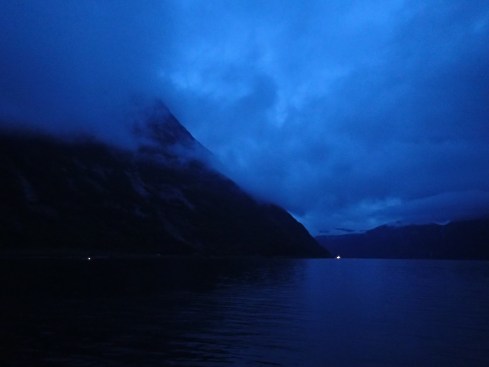
Yes that is the white light of the ferry off in the distance
The Swim – distance – 3.8km, planned duration – 1:20:00, actual time 1:20:17
As you all know, I have the good fortune of living in Toronto and having Lake Ontario at my front door. In addition, I had a coach who wanted me immersed in cold water as a key part of the training sessions. Consequently, I was very prepared for the swim, having done about 10 open water swims in water as cold as 8 degrees, averaged about 13 degrees, all giving me the psychological advantage that the fjord was not something to fear – in Greg’s words, don’t awfulize things. What I didn’t expect was the body contact that occurred throughout this race. With only 245 athletes and a huge body of water, I figured the field would thin out very quickly. This was not the case. I was conked in the head 3-4 times, smacked on the back and had lots of touches on the legs and arms. It was still not particularly light outside so I chalk up the contact to not being able to see too much. The water itself was relatively balmy, probably about 14-15, far warmer than the 11 or so that existed closer to the exit of the swim (where we had a pre-race swim on Friday). Sighting for this race was expected to be relatively easy or so I thought. I really didn’t pay close attention to the map, basically believing that as long as you keep the shore on your right and kayakers on your left, you were doing ok. The theory worked until we got to about 2.5km out at which point the “fire on the beach” came into view and that became the new sighting point. The fire was to the right of the swim exit by about 600m, which I had forgotten about and I had also forgotten (or not realized given I didn’t study the map!!) that the shore jutted out in two different areas. This meant that as i followed the flame, I was also swimming off track on 2 separate occasions. This led to me adding 200m to my swim. I finally got to the left turn buoy that was about 600m from the exit, things were still feeling good although the water was now much colder. we would now pass in front of the race hotel and cruise ship pier where lots of spectators were cheering us on – at this point I could hear and see Corbin as turned to breathe. Interesting to me, it got choppy at this point, which Corbin would suggest later came from boats. Finally I exited the water feeling quite good about things and my time seemed to be right on track. Out of the water I was in 146th place of the men and 165th overall, just outside of the black t-shirt position.
Transition 1 – planned duration 10mins; actual time 14:08
We had planned for transition to occur in 2 stages to get me as warm as possible quickly. Stage 1, take off the top of the wetsuit, put on a cycling jersey over my trisuit, add a wind-vest, rain jacket if it was raining (of course it was pelting down), reflective vest and then a down jacket (I would take this off prior to exit). I would then drink 300ml of warm nutrition (we had in the thermos) and eat a PB&J sandwich, while Dianne removed the neoprene booties, the bottom of the wetsuit and then added knee warmers, (I wore compression sleeves on my legs giving me full leg coverage), put on socks, shoes (they had toe warmers already on) then added “waterproof” cycling booties. Finally, on my hands I put on neoprene gloves – keeping the hands warm and dry – that is a funny. Turn on my front and back lights. Somehow in all of the excitement i forgot to put on my GPS tracker race belt. As I ran out of transition, I was stopped by a race official to check my lights, tracker and timing chip – 2 out of 3 ain’t bad – throw the bike against the fence and race back to Dianne to get the GPS tracker. As Stew always says, transitions are for resting and at 14 mins, this sure wasn’t quick!! Clearly this was not a record setting transition time but I was on the bike feeling comfortable and never in trouble. With that said, exiting the transition area, I had fallen 21 positions to 186th in the race – my work was cut out for me and meant I needed to make up positions on the bike, something that I was very comfortable I would be able to accomplish given it is my strength.
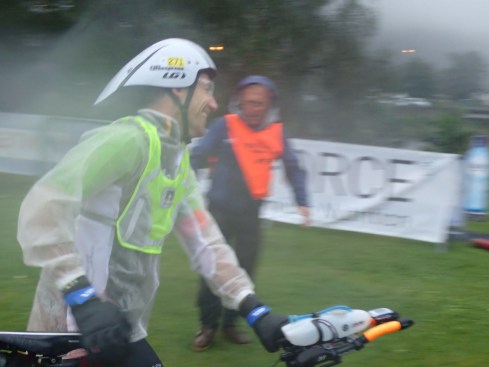
I was about to realize that I didn’t have my GPS tracker around my waist!
The Bike – distance 180km, vertical gain 10,000ft, planned duration 7:10:00; actual time 7:03:34
I was riding my time trial bike for this race and I believe in hindsight that was the right choice. While I think my climbing and descending might have been faster on a road bike, I don’t think there was enough of a difference to offset the efficiency gains that I experienced on the flat sections.
The description of the ride from the Athlete’s manual doesn’t seem to do it justice – 180km from Eidfjord by the Hardangerfjord; on National Road 7, up Måbødalen, across Hardangervidda to Geilo; National Road 40 across Dagalifjell to Uvdal, county roads over to Imingfjell to Tessungdalen, ending at transition zone (T2) in Austbygde by Lake Tinnsjøen. This fails to mention the 5 mountain pass climbs that we undertook, which resulted in vertical gain of 10,000 feet, sleet, hail, rain and sunshine – fleeting as it was.
The ride started with rain and that was a constant companion throughout the bike portion of the race. the first 5kms was relatively flat with the next 15kms climbing our first major mountain. We had driven this part of the course and I knew that the key was going to be a focus on keeping my inclination to go out hard in check – keep heart rate below 150 and power to something around 240-250 watts. As I was climbing, little by little, I was reeling people in and while i was little above expectations on HR and power, I was not being aggressive. I kept telling myself to stay in the moment, to focus on the next km, that I had trained to do all of these climbs even if I hadn’t trained for all of them in one day. the interesting thing about this race is that almost every competitor was supportive of each other. As you passed people they shouted encouragement. The other unique part of this race was the fact that you continuously saw the same support crews, moving back and forth on the roads as their athlete moved ahead or behind you – it very much reminded me of my Silver State 508 experience. One such competitor I got to know a bit was athlete 54 – Ingrid Assaaren; as we climbed up Mabodalen together. She was doing her first iron distance triathlon (and she picked this one!!) and her brother who was supporting her, had completed the Norseman 3 years earlier for his first iron distance race and placed 30th – clearly this was an athletic family. Unbeknownst to me, my crew had started to mark Ingrid – “pinkie” as they would call her – as an indicator of my approach (indeed she had a habit of putting time into me on the climbs and I would claw it back on the descents). Her brother would end up cheering me on, while Ingrid said that my crew was her second biggest supporter on the course.
We had agreed that the crew would see me at about 25km (no crew was allowed to support before 20km) and that Dianne would be about 500m ahead of the car holding out a Canadian flag, and then Corbin or Stewart would be ready with a feeding or hydration depending on the planned distribution. At 25km, it was mainly to ensure that everything was ok and that I was reminded to eat a gel, which I had forgotten I had on the bike. As i pushed past Dianne, she yelled at me to eat a gel, I yelled back that I didn’t have a gel – that sent her into a tizzy.
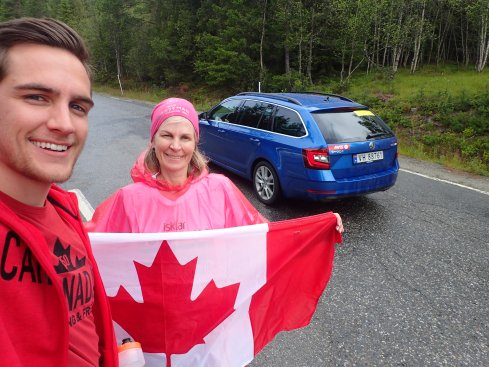
It was easy to spot my team with the Canadian Flag
They jumped into the car and raced ahead in order to tell me that I had the gels in my bento box on my bike, which I had remembered after yelling I didn’t have any – oh well that would not be the last lapse by my brain today. The bike race was the easiest part of this race for me despite what i thought were challenging conditions. The rain was continuous, mixed with sleet at points, but lucky for us, the winds were never really a big factor. This was a race that consisted of spending 20-40 minutes on a climb, just making sure that i was maintaining a strong tempo followed by 10-12 minutes of bombing down the mountain, hoping that cars didn’t get in the way. Of course, this happened from time to time as the roads remained open and there were at least 250 teams on the course supporting their athletes. My team would meet me every 5-10kms to provide a cheering squad at the side of the road (always with the flag) and would meticulously execute the feeding and hydration plan that had been set out by Coach Greg. Dianne ensured that I was getting the right fuelling to get me through to the run. The only real challenge came from the GPS belt which was too tight on my torso and instead of stopping and loosening it I just kept trying to shimmy it onto my hips only to have it rise up onto my gut creating pressure on my stomach – I think this would play out as a problem later. I knew I was going to have a decent day on the bike when I was able to have a huge pee at about 50km. This literally went on for a minute suggesting the fjord’s water levels must have dropped during my swim. Given it was pouring rain, no competitors were the wiser for my – on bike leak and my bladder was especially pleased.
The key to racing is to minimize the number of stops. To the extent you are moving, it is always better than stopping. With that said, if you crash while trying to strip off or put on clothing, the “savings” in time is easily jeopardized (I saw this in spades with James Young during the 24 hours of Sebring race, where a guy crashed and broke his collarbone, trying to change his jacket). During the cycling, I went through 2 changes of clothing and in both cases I stopped with my crew. In the first case, I stripped off my rain jacket and neoprene gloves, going to regular cycling gloves and wind vest – thinking the rain was done (FAT CHANCE), only to change again, stripping off all of the top gear down to my trisuit and adding on a wind shirt, a goretex jacket, and winter gloves – those were quite entertaining to get onto my wet cold hands.


The team was working hard to change my clothes and get me back on the road- those gloves just weren’t going on easily.
The most excitement to the bike component of the race came in the last 20kms as we descended from Imingfjell to transition 2. The road conditions here are a little dodgy and you can hit speeds of 70km/hr in the rain on a road with many potholes! It is definitely not the time to hit any pot holes and/or require emergency braking – particularly given my glasses were constantly blurred with rain drops. Stew had suggested that i had moved into a solid position and that I shouldn’t take any undue risks coming down the mountain. With that said, I hate giving up free speed when gravity is willing to pull my body weight down the mountain faster than those skinny mountain goats who beat me up the mountain. In any event I heeded Stew’s words given the hairpin technical turns that were a part of this descent. I got to witness a rider exit the road at the apex of a turn and lucky for her she was able to ride off into a runoff area without crashing her bike. Lucky for me I didn’t follow her line!! From that point, I focused on maximizing controlled speed in the rain. Thankfully my strength on the bike played out according to plan and I had been able to jump 55 places to 131st after the bike leg and now i was comfortably inside the 160 cutoff for the black t-shirt.
Transition 2, duration 6:03
I finally got to T2 to find Dianne waiting for me in transition. Again, quite a different experience from a normal triathlon as here everything is temporary. The area is used for the athlete to get in and out and for the crew to take all of the gear (bike included) with them for the running of the marathon. I peeled off all of the clothing, leaving me with just my trisuit, ate another PB&J sandwich and had some hydration in my run bottle. put on dry socks, changed my shoes, grabbed a hat and sunglasses and off I went (although my time would suggest i rested here also!)


Dianne and I are executing the transition, followed by me running out of T2
The Run, distance 42.2km, vertical 1,1719m or 5,640ft; actual time 7:31:01
Here is the understated description provided by the Athlete’s manual. 42.2km from Austbygde towards Rjukan, and to the top of Mt. Gaustatoppen. The first 25km are fairly flat, while the next 17.2km are a consistently steep climb up to 1850m.
This was going to be a run like no other. As many of you know, my achilles heel could very well be my run. Historically I have not thought of myself as a runner and if there was a weak link in my performance it seemed to show up on the run. Greg wanted me to focus on going out easy, building my pace and then settle into a strong rhythm. The run was going to be a tale of 3 elements – 0-25kms (flat), 25-32.5kms (zombie hill – it is called this for a reason) and 32.5kms-42.2kms (a challenging climb up a scree (the definition by Merriam-Webster doesn’t do this justice) ladened mountain). I exited transition feeling good about my legs and feeling pleased with myself that I was well within the 160 grouping. The challenge now was to maintain a running pace and not let my mind get ahead of me with good or bad thoughts – i kept repeating the mantra to stay in the moment! Greg had preached that everything that I would do today, I had done before. In every moment I had successfully completed the task at hand in training and racing. It was only when we string all of the moments together at the finish line that this race would be considered EPIC or XTREME; that is what I needed to keep reminding myself – stay in this moment.
It took some time for my support team to track me down as they had to disassemble and load the bike into the car. I also understood that Stew thought they must have passed me, because “there is no way, that the Quentin he knew, could be this far into the run – THANKS Stew!!! Greg had created a feeding and hydration plan for the run with hydration being mostly water, and fuel being the concentrated Infinit nutrition shots that i had been taking all day. Combine this with a gel and I should be well fuelled. I was pleasantly surprised by the run profile, it was indeed relatively flat during the first 25 kms. I was keeping a pace of between 5:30-6:00/km, which i was very comfortable with. By the 4th km I had been passed by 2 competitors, but I was still feeling strong and wasn’t worrying yet about my positioning. The team finally caught me and doled out my first feeding with Corbin running along side me to give me the bottle and take it back from me. My team did a great job of getting things to me without having me stop, a key piece of making up time. From that point I was passed by 1 more athlete around 10kms and now my mind kept wandering to the black t-shirt, visualizing the finish on Mt Gaustatoppen and on each occasion I had to haul myself back to the present, there was a lot of running still to be done with a huge climb up Zombie Hill. Every 2-3kms the crew would pull over, jump out and cheer me on. By 20kms I had overtaken 2 athletes and now sat very comfortably in 134th, 26 spots inside the black t-shirt cutoff. The crew provided one last feeding and they made their way to Zombie Hill where Dianne was going to pace me up the first 7.5kms of the mountain – where I would hope to be greeted by the race director, who would confirm my black t-shirt eligibility.
Zombie hill is a beast. While I have run up hills with similar grades and I got a 2.4km taste of Zombie hill on a race simulation day, nothing really prepares you for this at 25kms into a marathon after a fairly taxing bike ride and cold fjord swim. But hey, that is what makes Norseman Xtreme. I reached Zombie hill in 2 hours 28 minutes averaging just under 6 minute kms. I told Dianne to try and keep a strong pace as we power walked up the mountain. She could not be in front of me, but I just wanted her to ensure that we did not put in jeopardy the black t-shirt.


Dianne was pacing us up the mountain and carrying my hydration and nutrition.
At 2kms into Zombie I had gained more positions, sitting at 130 and feeling quite confident that 30 people were not going to overtake me in the remaining 5.5kms to the 32.5km checkpoint and black t-shirt cutoff. She kept encouraging me to use my arms and glutes but i was seriously flagging. My stomach was not responding well and the pressure from the GPS belt now seemed to be kicking in. I tried to vomit but to no avail, so I kept going, sipping water and hoping that I truly had built a big time buffer. Dianne told me we had 5 switchbacks to the top and by the third switchback i had lost 6 spots, still comfortable but I could tell by Dianne’s glances behind us that she was getting a little worried. The mountain kept going on and on and on and on and this was just to get to 32.5km, I still had 10 more to go after that, but at that point I just needed to finish.
With further encouragement, we finally turned the corner on what was arguably the 6th switchback to see the “interim” finish line – I was the 138th athlete to reach this point and the race director welcomed me to the check point and gave me the go ahead to finish at the top of Gaustatoppen – what a great feeling, there was a strong sense of accomplishment that I had executed exactly what I needed to do in order to get access to Gaustatoppen. At this point my body sagged, Dianne gave me a huge hug and physically held me up. It had taken us about 80 minutes to walk up 7.5kms – a slog to be sure and it was now about 6pm. I needed to get some energy back, because while I was now eligible for the black t-shirt, i still needed to run/walk – ok mostly walk, ok just walk!! another 10km.


The race director welcomes us to 32.5kms, I am holding on to Dianne or I might fall down, and my team is all smiles, ready for the next 10k. Half of Gaustatoppen can be seen behind us!
The first 5km of which got us to the start of the hike up Gaustatoppen and the medical check point, before the last 5kms of the race to the very top of the mountain at 1,895m. We went to the car where we had T3 – I had a change of clothes – into shorts, t-shirt, new jacket and new shoes (saucony peregrine 7 for the mountain scree climb) – got a back massage from Stew, and took in some additional calories. From my Garmin, it appears that we spent about 15 minutes just hanging around “T3”
This is an interesting race for any number of reasons not the least of which is time. For every ironman or any triathlon for that matter, I am constantly focused on my time in the race or my placement in my age group. At the Norseman, there are no age groups, so that battle to the finish line is against the other 245 competitors that started the morning on the Ferry. But the iconic nature of the Norseman is this notion of a BLACK T-SHIRT that I have mentioned about 20 times. Of course you could save yourself a lot of headaches by just buying a black Gildan t-shirt, but then again you wouldn’t experience the ultimate triathlon on the planet. By reaching 32.5kms inside the top 160 athletes, there were only 2 requirements, get to 37.5kms before 15 hours 30 minutes from the start or 8:30pm. From our spot, this meant we needed to get 5kms in 2.5 hours, seemed very achievable!! Then you needed to get to the finish line at the top of Mt. Gaustatoppen. If I knew then what I know now, this requirement definitely would have concerned me.


We made it to the mountain start (37.5km checkpt) how hard can it be from here?
At the 37.5km check point, they made sure that Dianne and I had all the necessary things in our back packs to be self sufficient going up the mountain and for Dianne to walk down the mountain (there is a funicular in the mountain that brings athletes down, but it was suggested that the crew have to walk down the mountain). Warm clothing – check, water bottle – check, warm hat – check, gloves – check, food – check; as you can tell this 5km effort is not a simple walk in the park – the conditions on the mountain can change rapidly, the wind can blow, the temperature can drop and things can get downright nasty. The skies had clouded over again, but no rain which would have made the footing even more tenuous than it already was. Think about climbing a mountain on rocks that are constantly shifting with many of them covered in water from natural snow runoff (yes snow in August!!). I was thankful to have my trail shoes on, while Dianne was not so lucky as her footing was challenged as she was still wearing regular running shoes. This was a slow slog going up the mountain. There were support crews streaming down the mountain and it soon became clear that we were likely the last team that was still going up the mountain. The fog had completely enveloped the mountain top and we were no longer able to see the final destination at the top of Gaustatoppen.


Breathtaking views but the climb was arduous
Every 20-30 minutes we would stop somebody coming down and ask “how much farther”? Each time they would give an answer that would befuddle us – notwithstanding us being slow, we thought we were going up, but it seemed like we were climbing on a treadmill. We just kept pushing to the top, taking in the scenery that was below us which was breathtaking, hoping that the top of the mountain would show itself at some point. Dianne was having challenges with her footing and Corbin was making sure that she was making progress. The winds were getting brisk and the temperature was dropping. This was not going to be much fun if we didn’t get to the top soon. Stew kept pushing me to move forward that we couldn’t stop for fear that i would begin to seize up. After several twists and turns and more encouragement from crews descending the mountain, we finally had the finish line in sight. We could no longer see Dianne and Corbin and I called out into the darkness and fog – no response. It worried me that they were not going to make it up to the top and I wasn’t crossing the finish line unless they were with me. Stew and I got to the building that houses the funicular and I told him that I would sit here to wait for them. The finish line was about 100m above us but I wanted to have Dianne and Corbin with us at the finish. Within about 5 minutes one of the Norseman crew suggested that they had arrived so we got ready for the final push. As we moved up the stairs, the medic crew was bringing an athlete down on a stretcher – not a great sign. Finally, I could fully see the finish line, I grabbed the Canadian flag from Dianne and ran it up to the top. I had finally made it to the end of this triathlon; this extreme triathlon; the toughest race I had experienced. My crew joined me at the finish line for a final photo in front of the skeleton crew that remained at the finish.


The last steps to the top, followed by the finishing photo
And so it was 16 hours, 15 minutes and 6 seconds after the gun sounded in the fjord, I had completed the Norseman Xtreme Triathlon. It mattered not one whit what time or place I had arrived in, I was going to the award ceremony tomorrow to pick up my black T-shirt, the same T-Shirt that would adorn Lars Christian Vold’s body – who would set a race record by finishing 6 hours and 23 minutes earlier in the day.
Epilogue
We were able to take 5 days post the race to unwind and experience the beauty of Norway (and the expense!). When I got home, I was greeted with one of the best Welcomes a Dad could experience. Austin and Maddie had taken to crafting a welcome that they felt was fitting for my accomplishment.
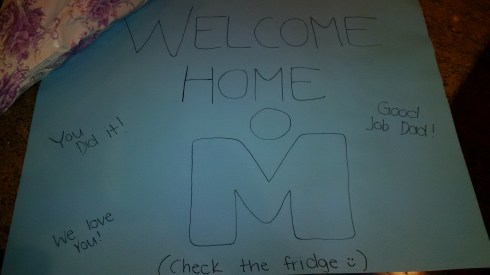
And I checked the fridge to find this wonderful cake!
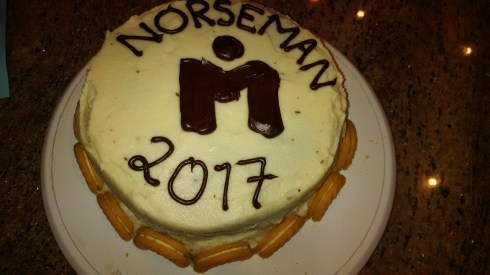 My kids keep my grounded but they are also my biggest fan club
 quentinbroad
Great story, Quentin – well done and congratulations!
Jamie